Reading Time: Approximately 10 minutes
Many women believe that becoming stronger after 50 means spending hours in the gym or lifting heavy weights. Fortunately, neither is true.
While our muscles naturally change as we get older, they continue to respond remarkably well to sensible exercise, good nutrition and consistent habits. You don’t need to train like an athlete to enjoy the benefits. Small, regular efforts can make everyday life noticeably easier, helping you stay independent, reduce the risk of falls, support healthy bones and keep doing the things you enjoy.
This guide looks at what the evidence tells us about building strength after 50, explains why it matters, and shares practical habits that fit comfortably into a normal life. If getting leaner is also part of your goal, our guide on the habits that actually help you get lean after 50 may help too.
A Story from Mrs Cure
One of my neighbours recently laughed as she struggled to lift two bags of shopping from the boot of her car.
“I must be getting old,” she smiled.
Perhaps.
Or perhaps she’d simply stopped asking her muscles to do much.
It’s an easy trap to fall into. As life becomes busier, many of us become less active without really noticing. Lifts replace stairs. Deliveries replace carrying shopping. Gardening becomes someone else’s job. Before long, our muscles quietly begin to disappear.
The good news is that muscles are surprisingly forgiving.
Even in our sixties, seventies and beyond, they respond when we ask them to work again. Not overnight, and certainly not through miracle programmes advertised online, but steadily and reliably.
That’s encouraging because strength isn’t really about muscles at all.
It’s about confidence.
Confidence that you can get up from the floor.
Confidence that you can carry your own suitcase.
Confidence that you can play with grandchildren without worrying about every little ache.
Those are goals worth working towards.
Why Strength Matters More After 50
Most of us expect our hair to turn grey as we age.
Few of us expect our muscles to quietly shrink.
Yet that’s exactly what happens.
From around our fifties onwards, many people begin to lose muscle mass naturally, particularly if they become less active. For women, the hormonal changes around menopause can make this process happen more quickly. Less oestrogen affects not only bone health but also muscle maintenance and recovery.
This isn’t something to fear.
It’s simply something to understand.
Muscle isn’t just there to help us look toned.
Healthy muscles help us:
- Stay steady on our feet.
- Protect our joints.
- Support healthy bones.
- Lift and carry everyday objects.
- Climb stairs more comfortably.
- Recover more quickly after illness.
- Remain independent for longer.
Strong muscles also use glucose more efficiently, helping the body regulate blood sugar, and they contribute to better balance and posture, both of which become increasingly important with age.
Perhaps the biggest benefit, however, is confidence.
Many women find that becoming stronger changes how they feel about ageing. Instead of seeing each birthday as another step towards frailty, they begin to recognise that many aspects of physical health remain within their influence.
That’s a much healthier way to think about growing older.
What the Evidence Says
One of the most encouraging findings in modern health research is that muscles continue responding to exercise throughout later life.
Researchers have repeatedly shown that adults well into their seventies, eighties and even nineties can improve strength through regular resistance exercise.
That doesn’t mean everyone will become an athlete.
It does mean that your body is far more adaptable than many people believe.
The greatest improvements usually come from consistency rather than intensity.
Two or three sensible strength sessions each week, combined with adequate protein and enough recovery, can produce meaningful improvements over time.
Progress may happen more slowly than it did at 25.
But progress is still progress.
There is no deadline after which becoming stronger is impossible.
Habit 1: Make Strength Training Part of Your Week
When people hear the words strength training, many imagine rows of heavy weights and intimidating gyms.
In reality, strength training simply means asking your muscles to work against some form of resistance.
That resistance might come from:
- your own body weight
- resistance bands
- light dumbbells
- household objects
- weight machines
- gardening
- carrying shopping
- climbing stairs
The best programme is the one you’ll actually continue doing.
For most women over 50, two or three sessions each week are enough to make a real difference.
Each session only needs to include a handful of simple movements that work the major muscle groups.
Think about movements you already perform every day:
- sitting down and standing up
- reaching overhead
- pushing
- pulling
- lifting
- carrying
Improving these movements improves everyday life.
You don’t need to exercise until you’re exhausted.
You simply need to give your muscles a reason to stay.
Habit 2: Eat Enough Protein
Exercise provides the signal.
Protein provides the building blocks.
Without enough protein, your body has a harder time repairing and maintaining muscle tissue.
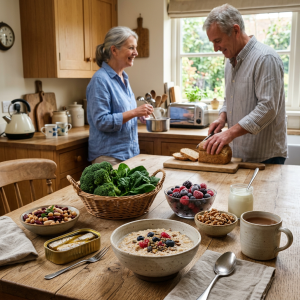
Many women unknowingly eat less protein than they need, particularly if breakfast consists only of toast or cereal.
Including a source of protein with each meal can make a noticeable difference over time.
Good options include:
- eggs
- fish
- chicken
- beans
- lentils
- Greek yoghurt
- cottage cheese
- tofu
- nuts and seeds
There’s no need to obsess over every gram.
Aim for a balanced diet containing enough protein across the day rather than trying to consume it all in one meal.
If you have kidney disease or another medical condition affecting your diet, it’s sensible to discuss your nutritional needs with your GP or a registered dietitian before making significant changes.
Habit 3: Keep Moving Between Workouts
It is tempting to think that strength only improves during exercise.
In fact, your everyday movement matters just as much.
Long periods of sitting can gradually reduce mobility, weaken muscles and leave joints feeling stiff. You do not need to become obsessed with counting steps, but finding reasons to move throughout the day can make a surprising difference.
Simple habits include:
- Walking while talking on the telephone.
- Taking the stairs when practical.
- Standing up every hour if you’ve been sitting for a while.
- Gardening.
- Household chores that involve lifting, carrying or stretching.
- Parking a little further away from the shops.
These activities are not a substitute for strength training, but they help reinforce an active lifestyle and prevent the “weekend warrior” approach, where all exercise is squeezed into one or two days.
Mrs Cure rather likes the idea of making movement a normal part of life instead of another item on the to-do list.
Habit 4: Give Your Body Time to Recover
Many of us were brought up believing that if exercise doesn’t leave you exhausted, it probably wasn’t worth doing.
Thankfully, that isn’t true.
Muscles become stronger while they recover, not while they’re working.
After a strength session, your body needs time, sleep and good nutrition to repair the tiny changes within muscle tissue. Constantly pushing through soreness can increase the risk of injury and make exercise something you begin to dread.
A sensible routine might involve strength exercises two or three times each week, with walking, gentle cycling or stretching on the days in between.
Listen to your body.
Feeling pleasantly worked is one thing.
Feeling pain that changes the way you move is quite another.
Habit 5: Don’t Forget Balance and Flexibility
Building strength is only one part of staying capable as we age.
Good balance reduces the risk of falls, while flexibility helps us move comfortably through everyday tasks.
The encouraging news is that you don’t need separate hour-long sessions devoted to either.
Standing on one leg while brushing your teeth, gentle stretching after exercise or trying an activity such as yoga or tai chi can all support better balance and mobility.
Think of strength, balance and flexibility as three legs of the same stool.
Remove one, and the others become less useful.
Habit 6: Progress Slowly and Consistently
One of the quickest ways to lose motivation is to expect dramatic results in a few weeks.
Strength doesn’t usually improve in great leaps.
It improves quietly.
Perhaps carrying the shopping feels easier.
Perhaps getting out of a low chair no longer requires both hands.
Perhaps your back aches less after gardening.
Those small victories matter.
They are signs that your body is adapting.
If an exercise becomes comfortable, gently increase the challenge by adding a little more resistance, an extra repetition or another set.
There’s no prize for progressing too quickly.
Consistency will almost always beat intensity.
Habit 7: Think Long Term
It’s easy to exercise for a holiday.
It’s much harder to exercise for the person you hope to be at 75.
That is the mindset worth cultivating.
Strength isn’t about looking younger.
It is about giving your future self every opportunity to remain active, capable and independent.
Every walk you take, every squat you perform from your chair and every healthy meal you prepare is an investment that your future self may quietly thank you for.
Mrs Cure has always believed that the best health habits are the ones that become so ordinary you hardly notice you’re doing them.
Common Myths About Strength After 50
“I’m too old to start.”
You almost certainly aren’t.
Research consistently shows that older adults can improve their strength when they begin exercising sensibly, even if they’ve never exercised before.
“I need a gym membership.”
Not necessarily.
Many effective strength exercises can be performed at home using body weight, resistance bands or a pair of light dumbbells.
“I’ll end up looking bulky.”
This is one of the most persistent myths.
Most women simply don’t have the hormonal profile needed to build large muscles naturally. What most notice instead is feeling stronger, steadier and more capable.
“It’s too late to make a difference.”
Every healthy choice you make today is an improvement on making that same choice next month or next year.
Your body rarely asks whether you’ve started late.
It simply responds to what you ask it to do now.
Mrs Cure’s Wise Take
There is something rather comforting about strength.
Unlike many fashionable health trends, it asks very little of us.
No expensive equipment.
No miracle supplements.
No impossible promises.
Just regular movement, sensible food, enough rest and the patience to keep going.
Growing older is inevitable.
Growing weaker is not inevitable to the same degree.
We cannot stop the passing of time, but we can influence how well we meet it.
That seems a worthwhile investment.
What You Can Do Today
You don’t need to overhaul your entire lifestyle.
Choose one or two simple actions instead.
Perhaps you could:
- Perform ten sit-to-stands from your favourite chair.
- Take a twenty-minute walk.
- Add a source of protein to tomorrow’s breakfast.
- Buy a resistance band.
- Schedule two strength sessions for next week.
- Practise standing on one leg while waiting for the kettle to boil.
Small actions repeated consistently often produce the biggest rewards.
Effort vs Benefit
| Habit | Effort | Likely Benefit |
|---|---|---|
| Two strength sessions each week | Moderate | Very High |
| Eating enough protein | Low | High |
| Walking every day | Low | High |
| Balance exercises | Low | Moderate to High |
| Sleeping well | Low to Moderate | High |
| Gradually increasing resistance | Moderate | Very High |
Things to Keep in Mind
- Begin slowly if you’re new to exercise.
- Good technique matters more than heavy weights.
- Some muscle soreness is normal. Sharp pain is not.
- If you have osteoporosis, arthritis, heart disease or another long-term medical condition, speak to your GP or an appropriately qualified healthcare professional before beginning a new exercise programme.
- Strength improves over months, not days.
Key Takeaway
Building strength after 50 doesn’t require endless hours in a gym.
It requires consistency.
Regular resistance exercise, sensible nutrition, everyday movement and adequate recovery can help many women remain stronger, steadier and more independent well into later life.
The goal isn’t to become someone else.
It’s to help yourself remain capable of enjoying the life you’ve worked so hard to build.
Mrs Cure Confidence Score
| Category | Rating |
|---|---|
| Evidence Strength | ⭐⭐⭐⭐⭐ |
| Practical Value | ⭐⭐⭐⭐⭐ |
| Ease of Following | ⭐⭐⭐⭐☆ |
| Cost | ⭐⭐⭐⭐⭐ |
| Suitability for Women Over 50 | ⭐⭐⭐⭐⭐ |
Overall Confidence: 9.5/10
Why?
The advice in this guide is strongly supported by current evidence around resistance training, healthy ageing and muscle maintenance. Individual needs vary, particularly where long-term health conditions are concerned, but the overall principles are well established, practical and achievable for most women.
Mrs Cure Wisdom
“Your future strength is built by the ordinary things you choose to do today. You don’t have to do everything. You simply have to keep doing something.”
Health Disclaimer
This article is intended for educational purposes only and should not replace personalised medical advice. If you have an existing medical condition, persistent pain or concerns about starting a new exercise programme, consult your GP or another appropriately qualified healthcare professional.