Prefer to watch? Here’s the 71-second version.
Opening Summary
If heartburn seems to be showing up more often than it used to, even after meals that never used to bother you, you’re noticing a real pattern. Acid reflux becomes more common with age for several physical reasons, not just diet. The good news is that it also responds extremely well to a handful of practical changes — most of which cost nothing and work within days.
The Story
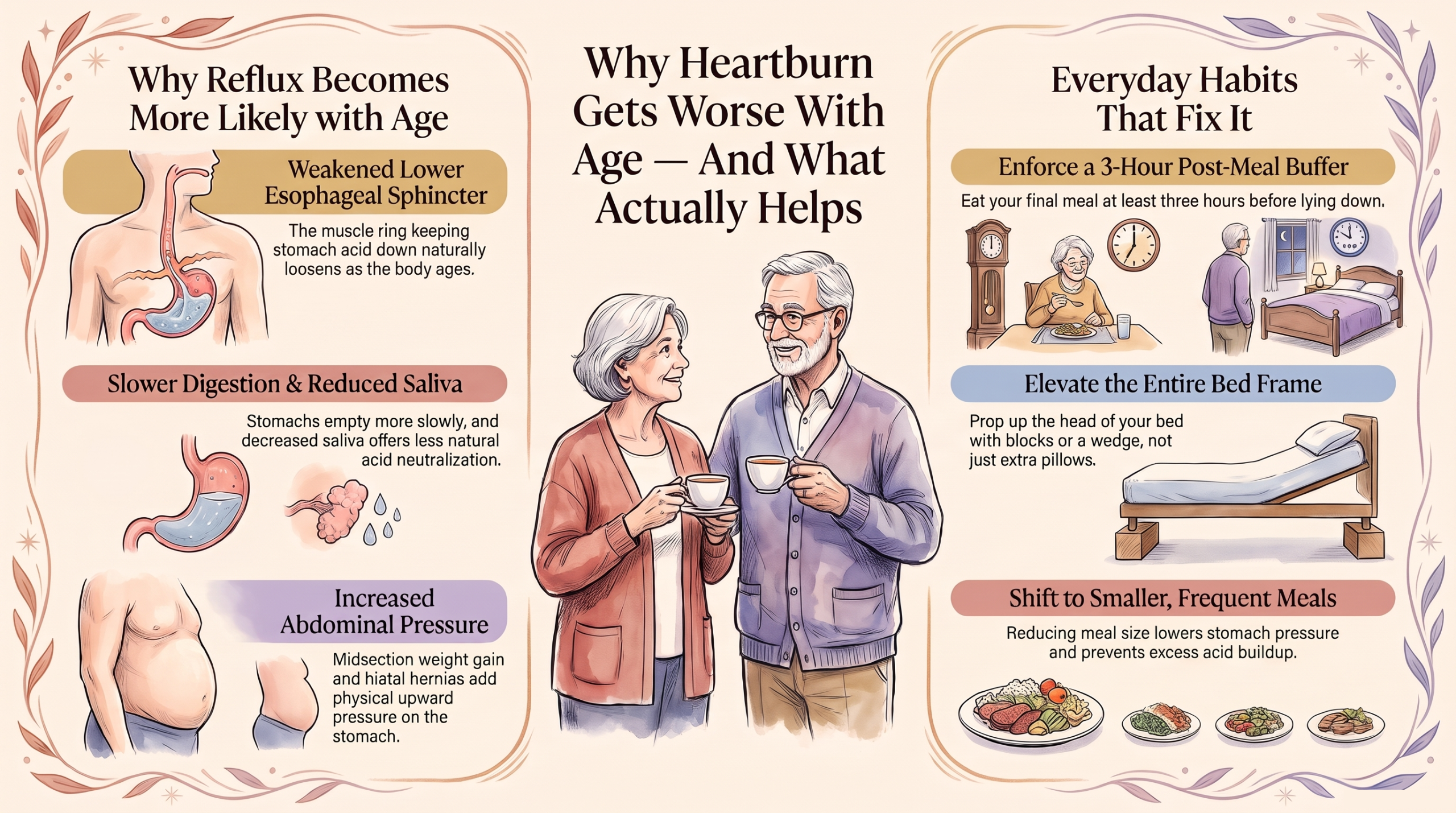
Acid reflux happens when the ring of muscle at the bottom of your oesophagus — the lower oesophageal sphincter — doesn’t close as tightly as it should, letting stomach acid travel back up. A few things make this more likely as the decades go on: the sphincter itself can weaken slightly with age, a hiatal hernia (where part of the stomach shifts up through the diaphragm) becomes more common, the stomach empties a little more slowly, and saliva — which naturally helps neutralise acid — decreases. Extra weight around the middle, which tends to creep on in this decade, adds physical pressure that makes reflux more likely too.
What actually moves the needle:
- Eat your last meal three hours before lying down. This one change alone resolves a surprising amount of nighttime heartburn, since lying flat on a full stomach is when acid travels back up most easily.
- Raise the head of your bed, not just your pillows. A wedge or blocks under the bed frame keeps your whole upper body elevated through the night, which stacked pillows alone don’t achieve nearly as well.
- Notice your personal trigger foods. Common culprits are caffeine, alcohol, chocolate, mint, citrus, tomato-based dishes and fatty or fried food — but triggers are genuinely individual, so a short food diary is more useful than a generic list.
- Check your medication cabinet. Certain blood pressure medications, some osteoporosis drugs, and regular anti-inflammatory painkillers can all make reflux more likely; ask your pharmacist if any of yours are on the list.
- Smaller, more frequent meals beat three large ones. A very full stomach has more pressure and more acid, both of which make reflux worse.
If lifestyle changes aren’t enough, over-the-counter antacids or acid reducers help most people — but if you find yourself needing something daily for more than a couple of weeks, that’s worth a conversation with your GP rather than a routine. Long-term use of the strongest acid-reducing medications works best when it’s a deliberate, monitored choice rather than an open-ended habit.

Mrs Cure Confidence Score
Evidence strength — Good
Practical value — High
Ease of following — Moderate
Cost — Free to low
Suitability for over 50s — Strong
Mrs Cure’s Wise Take
Heartburn has a way of making people feel like their own body has turned on them over something as ordinary as dinner. But most of the time, it’s just plumbing — a valve that’s a little looser than it used to be, asking for a bit more cooperation from timing and gravity. Small adjustments usually fix it faster than people expect.
What You Can Do Today
- Move your last meal earlier so there’s a clear three-hour gap before you lie down tonight.
- Prop up the head of your bed with blocks or a foam wedge, rather than relying on extra pillows alone.
- Jot down what you ate on your next bad heartburn day — a week or two of notes usually reveals your own personal triggers.
Effort vs Benefit
Low effort, often fast results. Most people notice a real difference within a week of adjusting meal timing and bed elevation alone, with no cost involved. Identifying personal food triggers takes a little patience over a couple of weeks, but pays off in a much shorter list of things you actually need to avoid, rather than cutting out everything at once.
Things to Keep in Mind
See your GP if you have difficulty or pain swallowing, unintended weight loss, persistent vomiting, or any sign of bleeding (vomiting blood or black, tarry stools) — these need a proper look rather than home management. Reflux that’s frequent for years without ever being checked is also worth a conversation, since there are a few related conditions worth ruling out. For ordinary, occasional heartburn, the everyday changes above are safe to try on your own first.
Key Takeaway
Acid reflux gets more common with age for straightforward physical reasons — not because anything has gone badly wrong. Meal timing, bed elevation and knowing your own trigger foods resolve it for most people without needing daily medication.
Mrs Cure Wisdom
Dinner shouldn’t follow you to bed. Give it a few hours’ head start, and it usually stays where it belongs.
Enjoyed this? Get The Good Years, free.
Our free monthly magazine, packed with the best of our articles, guides and quizzes for life after 50. No spam, unsubscribe any time.
This content is educational and not a substitute for personalised medical advice, diagnosis or treatment.