A shaking hand after 50 is far more likely to be essential tremor than Parkinson’s disease — and telling the two apart matters, because they’re treated completely differently.
Prefer to watch? Here’s the 68-second version.
Opening Summary
Noticing a shake in your hand for the first time after 50 is unsettling, and the mind often jumps straight to Parkinson’s disease. In reality, the most common cause of hand tremor at this age is something different and far more manageable: essential tremor. The two conditions can look similar at a glance, but they behave differently, respond to different treatments, and carry very different outlooks — which is exactly why getting an accurate diagnosis matters more than guessing from the internet.
The Story
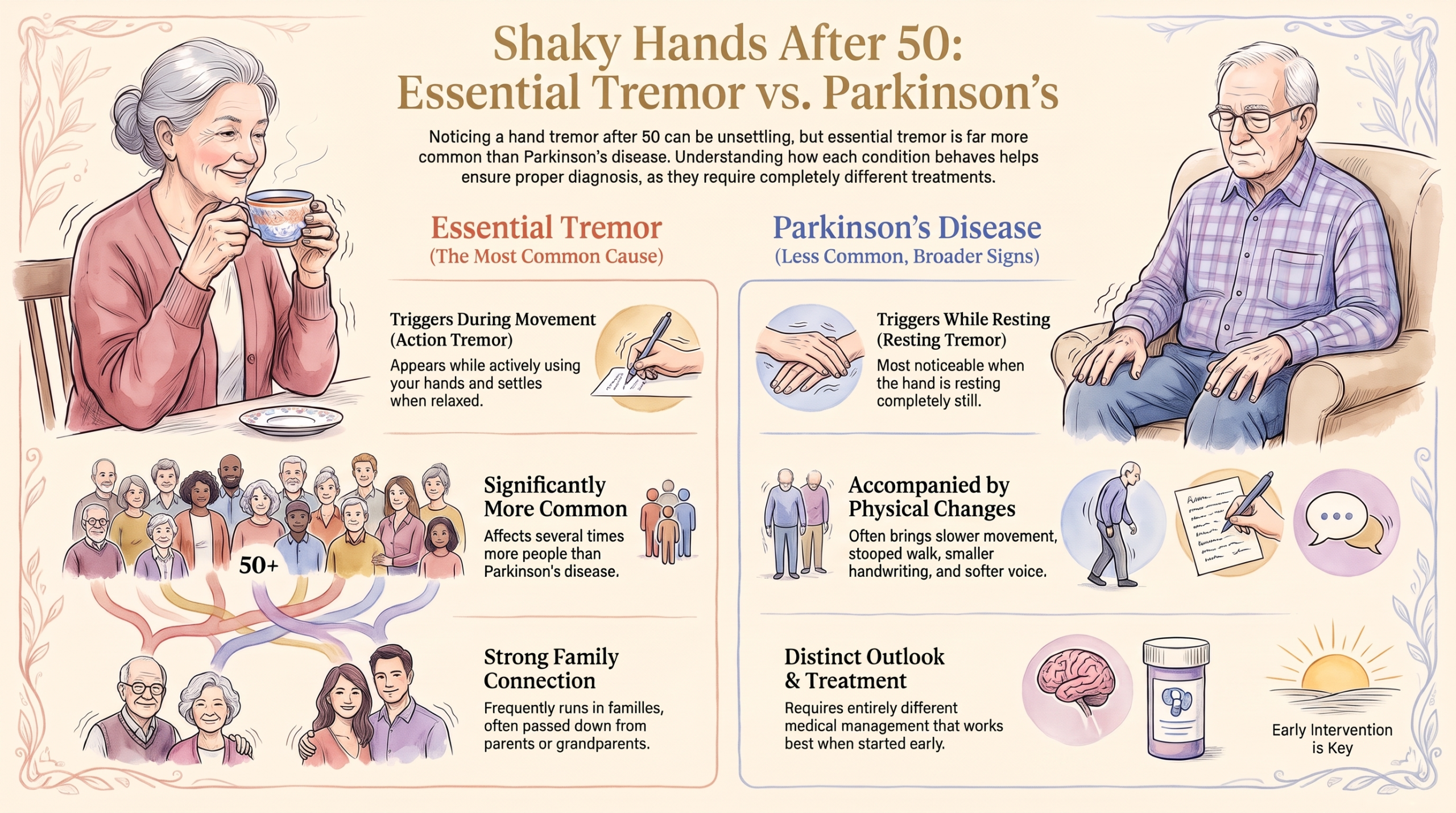
Essential tremor and Parkinson’s disease are the two conditions most often confused with each other, but a few clear differences usually separate them.
- Essential tremor shows up during action; Parkinson’s tremor shows up at rest. Essential tremor typically appears when you’re using your hands — holding a cup, writing, or reaching for something — and tends to settle when the hand is relaxed in your lap. Parkinson’s tremor classically does the opposite: it’s most noticeable when the hand is resting still and often eases during deliberate movement.
- Essential tremor is far more common. It affects an estimated several times more people than Parkinson’s disease, and its likelihood rises steadily with age. Having a tremor after 50 does not make Parkinson’s the likely explanation — statistically, it usually isn’t.
- Family history is a strong clue for essential tremor. It runs in families more often than not, so a parent or sibling with a similar hand shake is a meaningful piece of the puzzle a doctor will want to know about.
- Parkinson’s usually brings other signs beyond the tremor. Slower movement, a stooped or shuffling walk, reduced facial expression, smaller handwriting over time, and a softer voice tend to appear alongside the resting tremor. Essential tremor, by contrast, usually exists on its own without those accompanying changes.
- Both can affect voice or head, not just hands. Essential tremor sometimes involves a slight head nod or a shaky voice, which can be mistaken for other things if no one’s looking for tremor specifically.
- Neither diagnosis should be made from a video or a guess. A GP or neurologist can usually tell the two apart in a single visit through a physical exam and some simple observations, occasionally supported by imaging if the picture is unclear. Self-diagnosing from online symptom checkers, in either direction, tends to cause more anxiety than clarity.

Mrs Cure Confidence Score
Evidence strength — Good
Practical value — High
Ease of following — Moderate
Cost — Varies
Suitability for over 50s — Strong
Mrs Cure’s Wise Take
A shaking hand has a way of feeling like bad news before anyone’s actually looked at it. Most of the time, it isn’t the thing people fear most — and even when it is something more serious, knowing sooner rather than later is almost always the better position to be in.
What You Can Do Today
- Notice, and write down, when the tremor actually happens — while holding something still, or while your hand is resting — since that detail alone helps a doctor narrow things down quickly.
- Ask family members whether a parent, sibling, or grandparent had a similar hand shake, since family history is one of the most useful clues for essential tremor.
- Book a GP appointment to describe it properly rather than searching symptoms online first — a short, specific description in person gets you a far more useful answer.
Effort vs Benefit
The first step here is genuinely low effort — noticing a pattern and booking one appointment. The benefit is proportionally large: either real reassurance that this is common, manageable essential tremor, or an early start on Parkinson’s management, which research consistently shows works better the sooner it begins. There’s very little reason to delay finding out which one you’re dealing with.
Things to Keep in Mind
- A tremor that comes on suddenly, affects only one side severely, or arrives alongside weakness, confusion, or slurred speech needs urgent medical attention — that pattern is not typical of either essential tremor or Parkinson’s and may point to something else entirely, including a stroke.
- Caffeine, certain medications, low blood sugar, thyroid problems, and anxiety can all cause or worsen tremor, so a full medical review matters more than fixating on one explanation.
- Essential tremor sometimes responds to a small amount of alcohol, which is a diagnostic clue doctors ask about — it is not a recommended treatment, and should never be used as a substitute for proper management.
Key Takeaway
Most hand tremors that appear after 50 are essential tremor, not Parkinson’s disease, and the difference genuinely matters for how it’s managed. A short, specific conversation with a doctor — what the tremor does, when it happens, and who else in the family has had it — usually settles the question far faster than worrying alone ever will.
Mrs Cure Wisdom
Uncertainty is almost always worse than the answer, whichever answer it turns out to be.
Enjoyed this? Get The Good Years, free.
Our free monthly magazine, packed with the best of our articles, guides and quizzes for life after 50. No spam, unsubscribe any time.
This content is educational and not a substitute for personalised medical advice, diagnosis or treatment.