
Mrs Cure Learn · Free guide
Walking After 50: The Complete Plain-English Guide
How much you really need, how fast is fast enough, and a gentle 12-week plan to get you there.
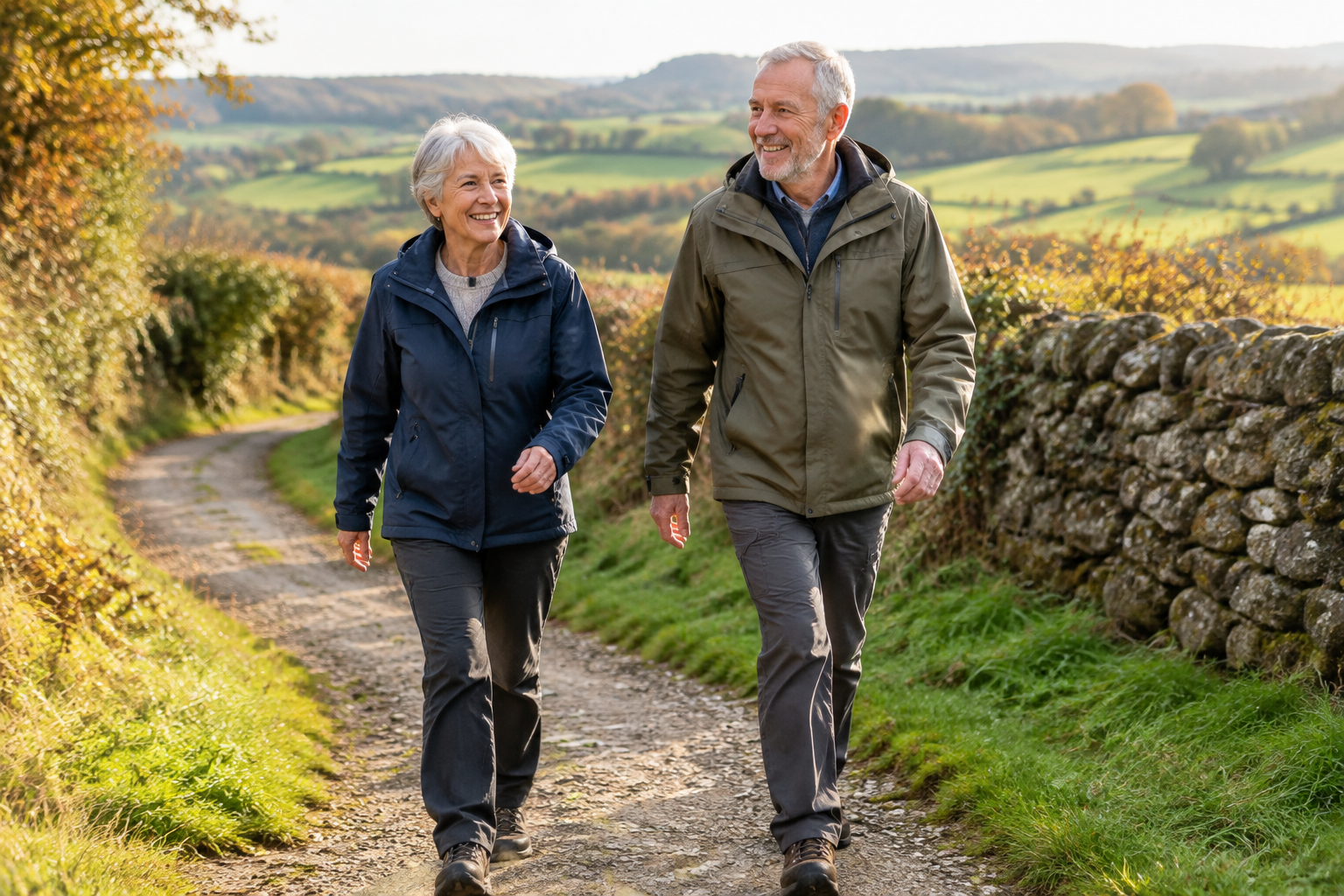
No gym, no Lycra, no monthly fee. Walking is the one form of exercise almost all of us can do, and the research on it keeps getting better. This guide cuts through the step-count myths and gives you everything you need to walk your way to a healthier heart, a sharper mind and steadier legs, whatever shape you’re starting from.
Prefer to watch? Here’s the 7-minute walk-through of the plan.
In this guide · about a 12-minute read
Why walking matters so much after 50
For years, walking was treated as exercise’s poor relation: fine for a Sunday afternoon, but not “proper” exercise. The research has changed that completely. In 2025, the biggest review of step counts ever carried out pulled together 57 studies from more than ten countries. Compared with people taking around 2,000 steps a day, those managing about 7,000 steps had a 47% lower risk of dying during the study and a 38% lower risk of dementia, with fewer cases of heart disease, type 2 diabetes, depression and falls too.
These studies follow people over time rather than testing walking in a lab, so they can’t prove walking alone did all the work. But the pattern is remarkably consistent, it’s backed by trials showing how walking helps, and it points in one very encouraging direction: you don’t have to do much more than you’re doing now to feel the difference.
Heart, blood and blood sugar
- Helps lower blood pressure
- Improves cholesterol and circulation
- Even a few minutes’ stroll after a meal blunts the rise in blood sugar
Brain and mood
- Linked with a lower risk of dementia
- One of the most effective exercises for easing low mood
- Better sleep, and a clearer head
Bones, joints and balance
- Weight-bearing, so it helps protect bone strength
- Keeps stiff joints moving and the muscles around them strong
- Uneven ground quietly trains your balance
On mood, a 2024 review in the BMJ of more than 200 trials found walking or jogging was among the most effective forms of exercise for easing depression. On blood sugar, studies show that a gentle walk of just a few minutes after eating lowers the spike that follows a meal, which is good news for anyone keeping an eye on type 2 diabetes risk. And because walking helps your heart and blood pressure, it helps your brain too, as we explain in blood pressure and the brain.
How much do you really need? (Forget 10,000)
The famous 10,000-steps target didn’t come from a laboratory. It began as the name of a Japanese pedometer sold in the 1960s, and it simply stuck. The real evidence is kinder, especially as we get older. A large 2022 analysis in The Lancet Public Health found that for adults over 60, the benefit to life expectancy levels off at around 6,000 to 8,000 steps a day. For under-60s it levels off a little higher, at 8,000 to 10,000.
| Daily steps | What the research suggests | Roughly what it looks like |
|---|---|---|
| Around 2,000 | The low starting point most studies compare against | Pottering around the house, a short trip to the car |
| About 4,000 | Already a real step up; the biggest gains come from moving out of the lowest group | Everyday life plus one 15-minute walk |
| 6,000 to 8,000 | The sweet spot for over-60s; most of the benefit is here | Everyday life plus 30 to 45 minutes of walking, which can be split up |
| 10,000 and more | Small extra gains for some outcomes, but no magic threshold | Lovely if you enjoy it, not a pass mark |
If you’d rather think in minutes than steps, the UK’s official advice for older adults is 150 minutes of moderate activity a week, which could be 30 minutes of brisk walking on five days, plus something to build strength and balance on two days a week. It all counts, however you break it up: three 10-minute walks do the job just as well as one 30-minute one.
What “brisk” actually means
Every step counts, but a bit of pace gives your heart and lungs more of a workout. You don’t need a gadget to tell if you’re walking briskly. Try these three simple checks.
1. The talk test. You can still hold a conversation, but you wouldn’t want to sing. That’s moderate intensity, and it’s the NHS’s own rule of thumb.
2. The step count. Count your steps for 15 seconds and multiply by four. Around 100 steps a minute (25 in 15 seconds) is moderate intensity for most adults, including people in their sixties, seventies and eighties.
3. The feel. You’re a little warmer, breathing a little faster, and you feel you’re going somewhere rather than window-shopping. For most people that’s around 3 miles an hour.
Want a bit more from your walk without making it longer? Try interval walking: three minutes of brisk walking, then three minutes at an easy pace, repeated. In a Japanese study of older adults, people who walked like this four days a week for five months improved their leg strength, fitness and blood pressure more than those who walked at one steady moderate pace.
It’s also worth knowing that doctors increasingly treat walking speed as a quiet signal of overall health in later life. If you’ve noticed you’ve slowed down a lot, gently building up your pace is one of the best things you can do, and a noticeable slowdown without a clear reason is worth mentioning to your GP.
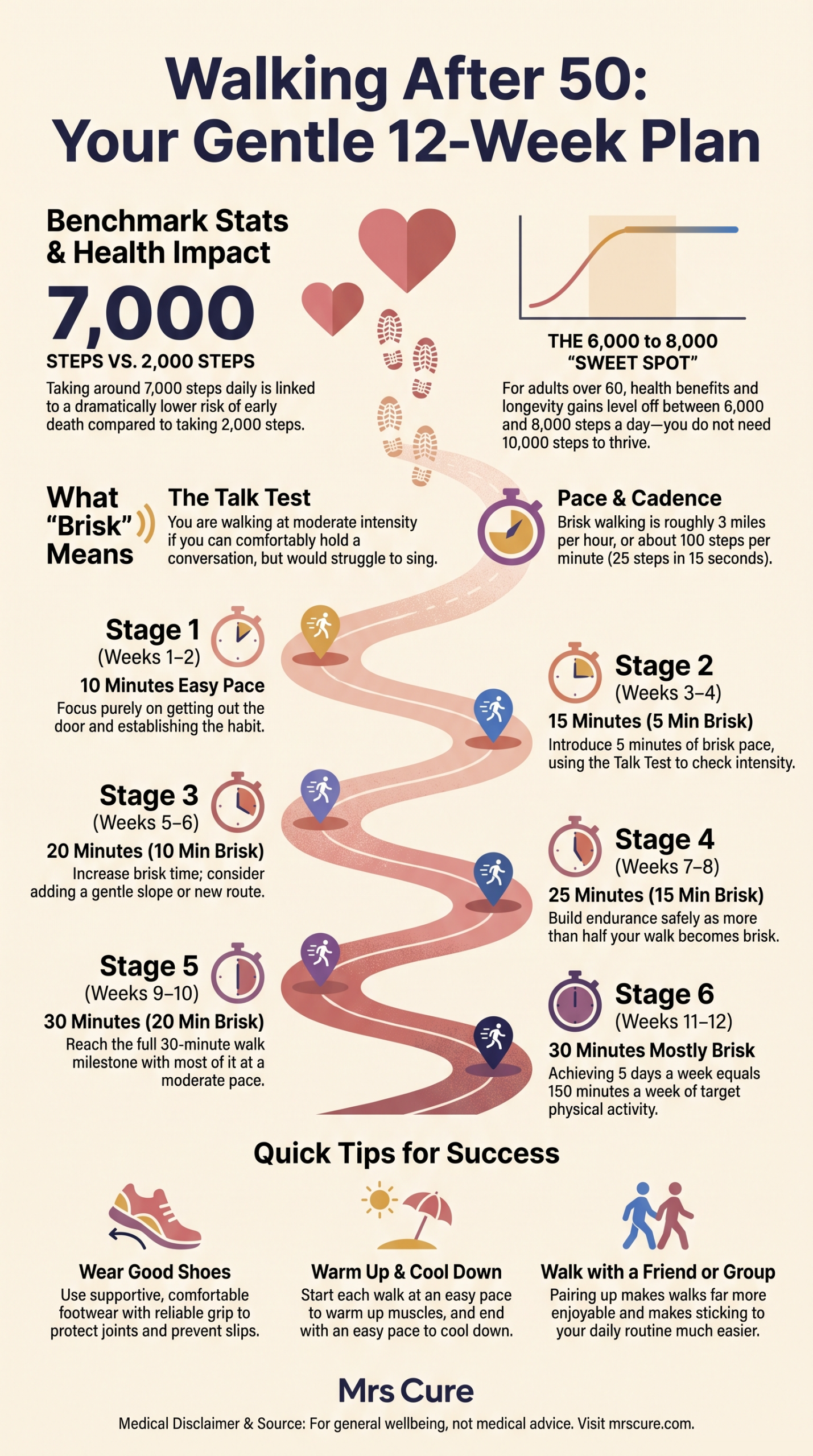
Your gentle 12-week walking plan
This plan starts where most people are, not where fitness magazines assume you are. If you’re already walking regularly, simply join at the stage that feels comfortable. Aim for five walking days a week, and take a rest day whenever you need one.
| Weeks | Each walk | What to focus on |
|---|---|---|
| 1 and 2 | 10 minutes at an easy pace | Just getting out of the door. Note your usual daily steps if you have a phone or pedometer. |
| 3 and 4 | 15 minutes, with 5 minutes brisk | Try the talk test in the brisk part. |
| 5 and 6 | 20 minutes, with 10 minutes brisk | Add a gentle slope or a different route. |
| 7 and 8 | 25 minutes, with 15 minutes brisk | Walk with a friend, or join a local group walk. |
| 9 and 10 | 30 minutes, with 20 minutes brisk | Once a week, try 3 minutes brisk, 3 minutes easy, five times. |
| 11 and 12 | 30 minutes, mostly brisk | That’s 150 minutes a week. Treat yourself to one longer, slower walk somewhere lovely. |
Stuck at a stage? Stay there for another week or two. There’s no prize for rushing, and the whole point is to build something you’ll still be doing next year.
Free printable
Get your 12-week walking plan and log
The whole plan on one page, with tick boxes for every walk and space to note your steps. In A4 and US Letter. Pop your email in and it’s yours straight away.
Walking with creaky knees, sore feet or wobbly balance
Aches and pains are the most common reason people give up walking, and often the most common reason they should keep going.
Knees and hips
NICE, which sets NHS treatment guidelines, recommends exercise for everyone with osteoarthritis and is clear that it doesn’t harm the joints. Some discomfort at first is normal. A handy rule: aches that settle by the next morning are fine; pain that’s worse the next day means ease off a little, not stop. Flatter routes and shorter, more frequent walks help. More in why your joints ache more after 50.
Feet and shoes
You don’t need expensive trainers, but you do need shoes that are cushioned, fasten securely and leave room for your toes. Shop in the afternoon when feet are at their largest, and replace shoes once the cushioning feels flat. If you have diabetes, check your feet every day. See foot health after 50.
Balance and confidence
If you feel unsteady, start on even paths and walk with someone. Walking poles, as used in Nordic walking, can add stability and work your arms too. Pair walking with simple balance exercises from our balance guide, and try the Balance & Fall-Risk Check.
Check with your GP before starting if you have a heart condition, have had recent surgery, get chest pain or breathlessness when you exert yourself, or have had several falls. That’s not a reason not to walk; it’s a reason to get the right advice on how to start.
When not to wait
Stop and call 999 (911 in the US) if you get chest pain or tightness, especially if it spreads to your arm, neck or jaw, or comes with breathlessness, sweating or feeling faint.
See your GP soon if you get a cramping pain in your calf, thigh or buttock that comes on when walking and eases when you stop. It’s called claudication and can be a sign of narrowed arteries in the legs, which is very treatable once found. The same goes for breathlessness that’s new or out of proportion to the effort.
Walking all year round, whatever the weather
Living in Britain means a walking plan needs a wet-weather clause. A little preparation keeps you going all year.
Cold and ice. Layers you can take off beat one thick coat, and a hat and gloves make a big difference. On icy days, stick to gritted routes, wear shoes with a good grip (clip-on ice grips are inexpensive), or walk indoors instead. A fall on ice isn’t worth the steps.
Heat. Walk early or late, carry water, wear a hat, and slow down on hot days. Many heart and blood pressure tablets make it easier to overheat or get dizzy.
Dark evenings. Wear something bright or reflective, carry a small torch, and stick to lit routes you know.
Indoor days. Walk laps of a shopping centre, use the stairs a few extra times, march on the spot through the adverts, or walk around the garden or house with the radio on. It all counts.
Making it stick
The best walking routine is the one you’ll still be doing next spring. These are the tricks that make the biggest difference.
1. Hitch it to something you already do. After your morning cuppa, after lunch, before the evening news. A habit that rides along with an old one is far more likely to last.
2. Walk with someone. It’s harder to cancel on a friend, and chatting makes the time fly. Walking groups are brilliant for this (see below).
3. Keep a simple record. Most smartphones count steps automatically, and the free NHS Active 10 app tells you when you’re walking briskly. Or just tick a box on a calendar.
4. Give walks a purpose. Post a letter, walk to the shops, take the long way to a friend’s, or leave the car at home for short trips.
5. Add a little interest. A new route, a podcast, a nature spot to check on each week, or a walk that ends at a café. Enjoyment isn’t a bonus; it’s what keeps you going.
Joining a group walk is one of the easiest ways to start, and it brings company as well as exercise. These are free and led by friendly volunteers, and you can simply turn up.
In the UK
England: Ramblers Wellbeing Walks, short free walks at a steady pace
Scotland: Health Walks from Walking Scotland (formerly Paths for All)
Wales and Northern Ireland: ask your local council or Ramblers group about free health walks
Sore joints? Versus Arthritis helpline: 0800 5200 520
In the US
Walk with a Doc: free community walks led by local health professionals
Walk With Ease: a six-week walking programme from the Arthritis Foundation
Elsewhere, your national walking charity or local council is the best place to ask.
Five walking myths, gently corrected
“Walking isn’t proper exercise.”
A brisk walk is moderate-intensity exercise by any official definition, and it’s the activity behind much of the strongest research on living longer and staying well.
“I need 10,000 steps or it doesn’t count.”
For over-60s, most of the benefit comes by 6,000 to 8,000 steps, and the biggest gain of all comes from moving out of the lowest group.
“Walking will wear out my knees.”
For most people with arthritis, regular walking eases pain and stiffness over time. Joints are designed to move; it’s inactivity that lets the supporting muscles weaken.
“Short walks are a waste of time.”
UK guidelines dropped the old “at least 10 minutes at a time” rule in 2019. Every bout counts, and a few minutes after a meal helps your blood sugar.
“I’ve left it too late.”
People who start walking in their sixties, seventies and beyond still see real improvements in fitness, strength, mood and balance. The best time to start was years ago; the second best is this week.
Mrs Cure Confidence Score
Evidence strength — Strong
Practical value — Very high
Ease of following — Easy
Cost — Free
Suitability for over 50s — Excellent
Mrs Cure’s Wise Take
If walking came in a bottle, we’d all be queueing at the chemist for it. It asks for nothing more than a pair of comfortable shoes and a bit of your day, and it gives back a stronger heart, steadier legs, better sleep and a brighter mood. Start smaller than you think you should, be patient with yourself, and let the habit grow. The walk you actually take always beats the perfect one you keep planning.
Key Takeaway
Walking is one of the best-evidenced things you can do for your health after 50. For over-60s, most of the benefit comes by 6,000 to 8,000 steps a day, or around 150 minutes of brisk walking a week, and it all counts in short bouts. Build up gradually, walk briskly enough that you can talk but not sing, and don’t let creaky knees put you off: for most people, walking helps rather than harms.
Mrs Cure Wisdom
You don’t have to walk far. You just have to keep walking.
Keep going
Enjoyed this? Get more like it.
Practical, no-nonsense health tips for adults 50+, dropped straight in your inbox. No spam, unsubscribe anytime.
Sources and further reading
- Ding D, et al. Daily steps and health outcomes in adults: a systematic review and dose-response meta-analysis. The Lancet Public Health, 2025.
- Paluch AE, et al. Daily steps and all-cause mortality: a meta-analysis of 15 international cohorts. The Lancet Public Health, 2022.
- del Pozo Cruz B, et al. Association of daily step count and intensity with incident dementia in 78,430 adults living in the UK. JAMA Neurology, 2022.
- Noetel M, et al. Effect of exercise for depression: systematic review and network meta-analysis of randomised controlled trials. BMJ, 2024.
- Buffey AJ, et al. The acute effects of interrupting prolonged sitting time in adults with standing and light-intensity walking on biomarkers of cardiometabolic health. Sports Medicine, 2022.
- Tudor-Locke C, et al. Walking cadence (steps/min) and intensity in 61 to 85-year-old adults: the CADENCE-Adults study. IJBNPA, 2021.
- Nemoto K, et al. Effects of high-intensity interval walking training on physical fitness and blood pressure in middle-aged and older people. Mayo Clinic Proceedings, 2007.
- Studenski S, et al. Gait speed and survival in older adults. JAMA, 2011.
- UK Chief Medical Officers’ Physical Activity Guidelines, 2019. NHS: Physical activity guidelines for older adults; Walking for health.
- NICE guideline NG226: Osteoarthritis in over 16s, 2022.
This content is educational and not a substitute for personalised medical advice, diagnosis or treatment.