
Mrs Cure Learn · Free guide
Your Memory After 50: The Complete Plain-English Guide
What really changes, what can be put right, and what you can do from today.

Forget a name at a party, walk into the kitchen and wonder why, and a small voice starts asking questions. This guide is here to answer them properly: what really changes in a brain after 50, what doesn’t, what can be put right, and what you can do from today to protect the mind you’ve got.
Prefer to watch? Here’s the 70-second version.
In this guide · about a 12-minute read
- What really changes in the brain after 50 (and what doesn’t)
- Normal ageing, mild cognitive impairment and dementia: three different things
- Before you worry: ten treatable things that look like memory decline
- The 14 things that shape your dementia risk
- Your brain MOT: six checks worth doing
- If you’re worried: how to talk to your GP
- Five memory myths, gently corrected
What really changes in the brain after 50 (and what doesn’t)
Your brain ages, just as your knees and your eyesight do. From midlife onwards it very gradually loses volume, particularly in the areas that handle new learning and quick processing, and the messages between brain cells travel a little more slowly. None of that is a disease. It’s the brain equivalent of needing reading glasses.
What surprises most people is how selective the change is. Some abilities do slow down. Others hold steady for decades, and a few genuinely get better.
Tends to slow down
- Speed of thinking and reacting
- Pulling up names and words on the spot
- Juggling several things at once
- Learning something brand new quickly
Usually holds steady
- Long-term memories and life stories
- Skills you’ve practised for years
- Attention on one task at a time
- Everyday reasoning and planning
Can actually improve
- Vocabulary and general knowledge
- Judgement built on experience
- Keeping calm and handling emotions
- Seeing the bigger picture
So the classic “tip of the tongue” moment, where you know the actor’s name and it simply won’t come until you’re halfway through the washing-up, is the brain’s retrieval speed at work, not its storage failing. The memory is there. It’s just taking the scenic route.
And the slow-down isn’t fixed. Research on so-called “SuperAgers”, people in their eighties with the memory of someone decades younger, suggests that how we live has a real say in how our brains age. We cover that in what SuperAgers are teaching us about the brain.
Normal ageing, mild cognitive impairment and dementia: three different things
These three terms often get muddled together, which is where a lot of needless fear comes from. They sit on a spectrum, but they’re not the same thing, and moving along it is not inevitable.
| Normal ageing | Mild cognitive impairment (MCI) | Dementia | |
|---|---|---|---|
| What it is | The gradual, expected slowing that happens to everyone | Memory or thinking noticeably worse than expected for your age | A decline in memory and thinking caused by disease in the brain |
| Daily life | Not affected | Still managing independently, perhaps with more notes and reminders | Everyday tasks become genuinely difficult |
| Typical example | Forgetting a name, then remembering it later | Regularly missing appointments or losing the thread of conversations | Getting lost on a familiar route, struggling with bills you’ve always handled |
| What happens next | Stays mild | Many people stay stable or even improve, especially when a cause is found and treated | Usually progresses, though treatment and support make a real difference |
The most useful single question isn’t “what did I forget?” but “is it getting in the way of my life?” A second one is just as telling: has someone close to you noticed a change you hadn’t? If you’d like a side-by-side list of everyday examples, our article Normal Forgetfulness vs Something More walks through them one by one.
Before you worry: ten treatable things that look like memory decline
This is the section most people never hear about, and it’s the most reassuring of all. A good number of memory problems in later life turn out to have a cause that can be found and treated, often with a blood test, a change of tablet or a better night’s sleep. That’s exactly why GPs check for them first.
1. Low vitamin B12. Absorbing B12 gets harder with age, and some common medicines (including metformin and long-term indigestion tablets) make it harder still. Low levels can cause forgetfulness, tiredness and pins and needles. A simple blood test tells you.
2. An underactive thyroid. It’s far more common after 50 than most people think and can bring brain fog, slowness and low mood. Our guide to thyroid health after 50 explains the quick blood test that checks it.
3. Depression and anxiety. Both can flatten concentration so much that memory seems to go. Doctors sometimes call it “pseudodementia”, and it usually lifts once the low mood is treated.
4. Poor sleep and sleep apnoea. Your brain files away the day’s memories while you sleep. Loud snoring, gasping at night or waking unrefreshed can point to sleep apnoea, which is very treatable.
5. Medicines. Some tablets for bladder problems, allergies, sleep, pain and older-style antidepressants can dull memory, and the effect builds when several are taken together. Never stop anything yourself, but do ask your GP or pharmacist for a review. See managing multiple medications safely.
6. Infections. In older adults, a urine or chest infection can cause confusion before any other symptom appears.
7. Alcohol. The same drink affects us more after 50, and regular heavier drinking takes a real toll on memory. Our piece on how your body processes alcohol after 50 explains why.
8. Hearing and eyesight. You can’t remember what you never properly heard or saw. Straining to follow a conversation also uses up the mental energy that would otherwise go into remembering it.
9. The menopause. Brain fog around the menopause is real and common, and for most women it eases afterwards.
10. Stress and overload. A frazzled mind isn’t a failing one. It simply has no room left to lay down new memories.
When not to wait
Memory changes that creep in over months are a matter for a routine GP appointment. Sudden confusion, over hours or a day or two, is different and needs same-day help: call your GP or NHS 111 (in the US, your doctor or an urgent care clinic). If it comes with a drooping face, a weak arm or slurred speech, call 999 (911 in the US) straight away.
The 14 things that shape your dementia risk
In 2024, the Lancet Commission on dementia, one of the most authoritative reviews in the field, pulled together the world’s evidence and reached a striking conclusion: nearly half of all dementia cases could, in theory, be prevented or delayed by tackling 14 risk factors across a lifetime.
That doesn’t mean anyone who develops dementia did something wrong. Age and genes still play the biggest part, and plenty of people who “do everything right” are still affected. But it does mean the odds aren’t fixed, and that most of these factors are things we can do something about, even from 50, 60 or 70.
Heart and blood vessels
High blood pressure · high LDL (“bad”) cholesterol · diabetes · obesity · smoking · too much alcohol · physical inactivity
What’s good for your heart is good for your brain, which uses around a fifth of your body’s energy.
Your senses
Hearing loss · untreated sight loss
Hearing loss is one of the single biggest risk factors on the whole list, and one of the easiest to act on.
Mind and company
Depression · social isolation · less education and mental challenge earlier in life
A busy, connected, curious life builds “cognitive reserve”, the brain’s spare capacity.
Surroundings and safety
Head injury · air pollution
Wear a helmet on a bike, take falls seriously, and choose quieter back streets for walks where you can.
The two newest additions
High LDL cholesterol and untreated sight loss were added to the list in 2024. The Commission estimates that high LDL cholesterol in midlife accounts for around 7% of dementia cases. That puts it level with hearing loss at the top of the list, and it’s something a routine blood test picks up. Untreated sight loss adds another 2%, often caused by cataracts, which are among the most successfully treated conditions in medicine.
Why hearing deserves a special mention
Hearing loss creeps up so slowly that many of us are the last to notice it. When the brain has to strain to make sense of muffled sound, it has less left over for thinking and memory, and people with poor hearing also tend to withdraw from conversation, which brings isolation with it. In the ACHIEVE trial, published in 2023, older adults at higher risk who were fitted with hearing aids saw their thinking skills decline 48% more slowly over three years than those who weren’t. (In the healthier group the difference was small, which tells us hearing aids matter most for those who need them most.) Our article on hearing loss and the brain goes into more detail.
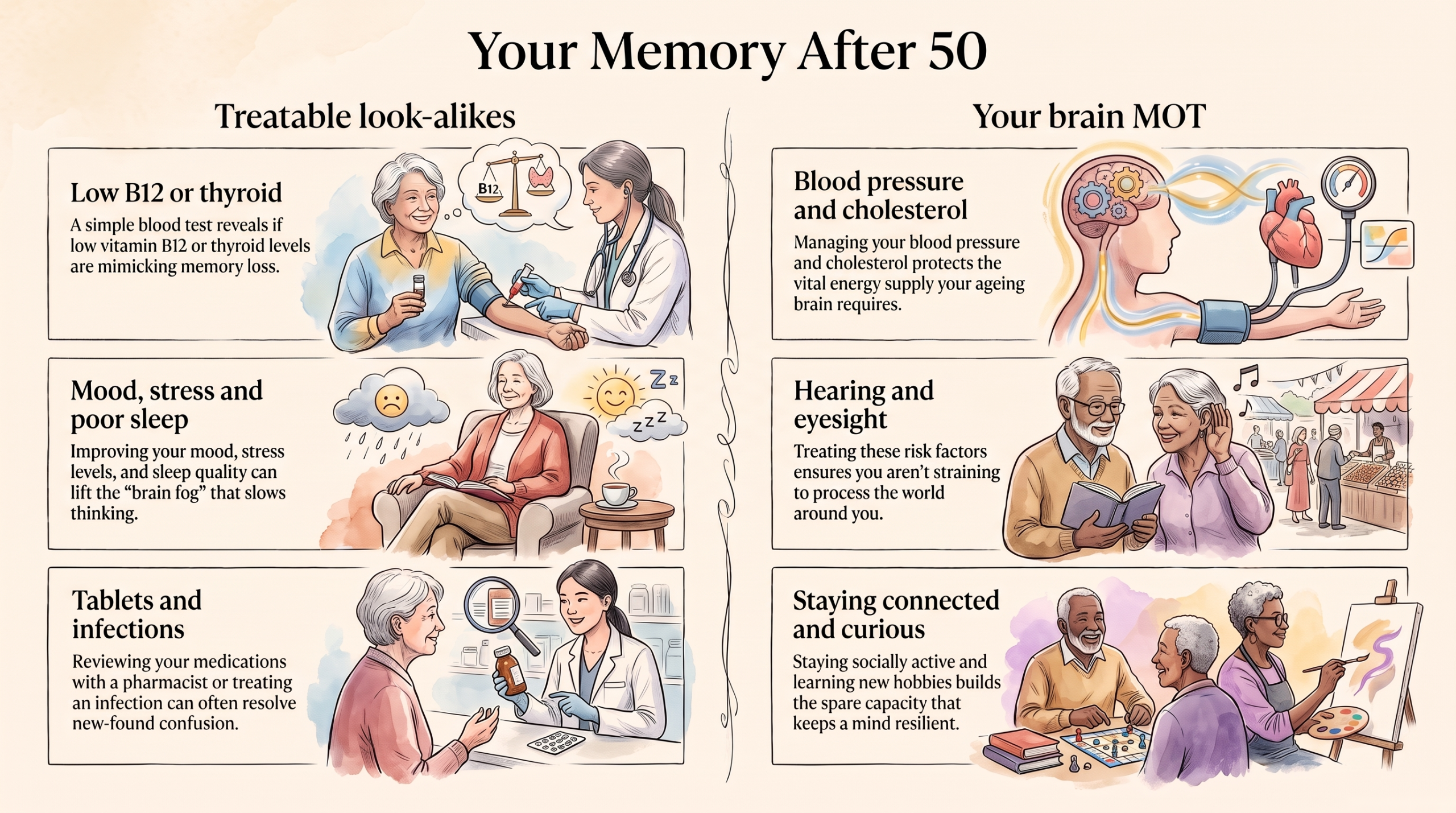
Your brain MOT: six checks worth doing
Think of this as an annual service for the brain. In the UK most of it is free on the NHS (there’s a note for US readers just below the table), and none of it is complicated. Tick off what you can this year.
| Check | Why it matters for your brain | Where to get it (UK) |
|---|---|---|
| Blood pressure | High blood pressure quietly damages the small vessels feeding the brain | GP surgery, many pharmacies, or a home monitor |
| Cholesterol | High LDL is now a recognised dementia risk factor | Blood test via your GP |
| Blood sugar (HbA1c) | Diabetes damages the small blood vessels that feed the brain | Blood test via your GP |
| Hearing | One of the largest modifiable risk factors of all | Free tests at many high-street opticians and hearing centres; NHS hearing aids via your GP |
| Eyes | Untreated sight loss was added to the risk list in 2024 | NHS sight tests are free once you’re 60 (free for everyone in Scotland) |
| Mood and sleep | Depression and poor sleep both affect memory now and brain health later | An honest chat with your GP; ask about sleep apnoea if you snore loudly |
Reading in the US? If you’re on Medicare, the yearly Annual Wellness Visit costs nothing and includes a check on memory and thinking, so it’s a natural place to start. Original Medicare doesn’t usually cover routine eye tests or hearing aids, but over-the-counter hearing aids have been sold without a prescription since 2022 at a fraction of the old price. Check your own plan for anything else.
Free printable
Get your one-page Brain MOT
All six checks on one sheet, with space for your results and notes for your GP. In A4 and US Letter. Pop your email in and it’s yours straight away.
Alongside the checks, the everyday habits that protect the brain are the familiar, unglamorous ones: moving most days (even walking counts), not smoking, keeping alcohol modest, seeing people you enjoy, and giving your brain something new to chew on. We’ve gathered the simplest of them in simple daily habits to keep your mind strong.
If you’re worried: how to talk to your GP
If memory changes are affecting your day-to-day life, or someone close to you has mentioned them, the GP is the right first step. It’s a far less daunting appointment than most people imagine, and more often than not it ends with reassurance or a treatable answer.
Before you go
- Jot down specific examples: what happened, when, and how often
- List every medicine you take, including supplements and anything bought over the counter
- Ask for a longer or double appointment if you can
- Take someone with you: a second pair of ears helps, and they may have noticed things you haven’t
What usually happens
- Questions about your symptoms, health and family history
- A look at your medicines
- Blood tests to rule out things like thyroid problems and low vitamins
- A short memory and thinking test, usually five to ten minutes
- If needed, a referral to a memory clinic for a fuller assessment
If you’d like to talk things through first, these lines are there for exactly that. You don’t need a diagnosis to call.
In the UK
Alzheimer’s Society Dementia Support Line: 0333 150 3456
Alzheimer’s Research UK Infoline: 0300 111 5555
In the US
Alzheimer’s Association 24/7 Helpline: 1-800-272-3900
Elsewhere, your national Alzheimer’s or dementia charity is the best first call.
Five memory myths, gently corrected
“Memory loss is just part of getting old.”
Some slowing is. Memory loss that disrupts your life isn’t, and it deserves a proper look rather than a shrug.
“If my parent had dementia, I’m bound to get it.”
Family history raises the odds a little for most people, but it isn’t destiny. Rare inherited forms do exist; they usually start unusually young and run strongly through several generations.
“A supplement will protect my memory.”
The evidence is disappointing. A large trial of ginkgo biloba in over 3,000 older adults found it did not reduce dementia, and fish-oil capsules have mostly underwhelmed in people who aren’t deficient. Vitamin B12 helps if you’re genuinely low, which is exactly why a blood test beats guesswork. Some supplements, ginkgo included, can also interact with blood thinners, so always check with a pharmacist.
“Brain-training apps will keep me sharp.”
They make you better at the app. Real-world challenges seem to do more: learning a language or instrument, a new hobby, a demanding conversation, finding your way somewhere unfamiliar. Variety and a little difficulty are the magic ingredients.
“It’s too late for me to make a difference.”
The Lancet Commission’s own words: it is never too early and never too late. Treating hearing loss, controlling blood pressure and staying active all count, whatever your age.
Mrs Cure Confidence Score
Evidence strength — Strong
Practical value — Very high
Ease of following — Easy
Cost — Mostly free
Suitability for over 50s — Strong
Mrs Cure’s Wise Take
Worrying about your memory is completely understandable, but worry on its own doesn’t protect anything. The gentler, more useful path is to get curious instead: rule out the treatable causes, book the hearing and eye tests you’ve been putting off, keep your heart in good shape, and keep saying yes to things that stretch you a little. That isn’t a recipe for fear. It’s a recipe for a good life, which happens to be good for your brain too.
Key Takeaway
Some slowing of memory after 50 is normal and nothing to fear. Memory changes that affect daily life deserve a GP visit, and many turn out to have treatable causes. Nearly half of dementia risk is linked to things we can influence, above all blood pressure, cholesterol, hearing, sight, activity and staying connected, and it is never too late to start.
Mrs Cure Wisdom
Look after your heart, your ears and your friendships, and your memory will thank you for all three.
Keep going
Enjoyed this? Get more like it.
Practical, no-nonsense health tips for adults 50+, dropped straight in your inbox. No spam, unsubscribe anytime.
Sources and further reading
- Livingston G, et al. Dementia prevention, intervention, and care: 2024 report of the Lancet standing Commission. The Lancet, 2024.
- Lin FR, et al. Hearing intervention versus health education control to reduce cognitive decline in older adults with hearing loss (ACHIEVE). The Lancet, 2023.
- DeKosky ST, et al. Ginkgo biloba for prevention of dementia (GEM study). JAMA, 2008.
- Alzheimer’s Society: Causes of memory problems; Dementia assessment with your GP.
- Alzheimer’s Research UK: What happens at the GP?
- NHS: Memory loss (amnesia).
This content is educational and not a substitute for personalised medical advice, diagnosis or treatment.