Prefer to watch? Here’s the 77-second version.
Opening Summary
If you’ve noticed a faint ringing, buzzing or hissing sound that nobody else can hear, you’re far from alone. Tinnitus becomes noticeably more common from your 50s onward, and for most people it’s a nuisance rather than a danger sign. It usually isn’t a symptom of anything serious, and there’s a surprising amount you can do to take the edge off it — starting with understanding what’s actually going on.
The Story
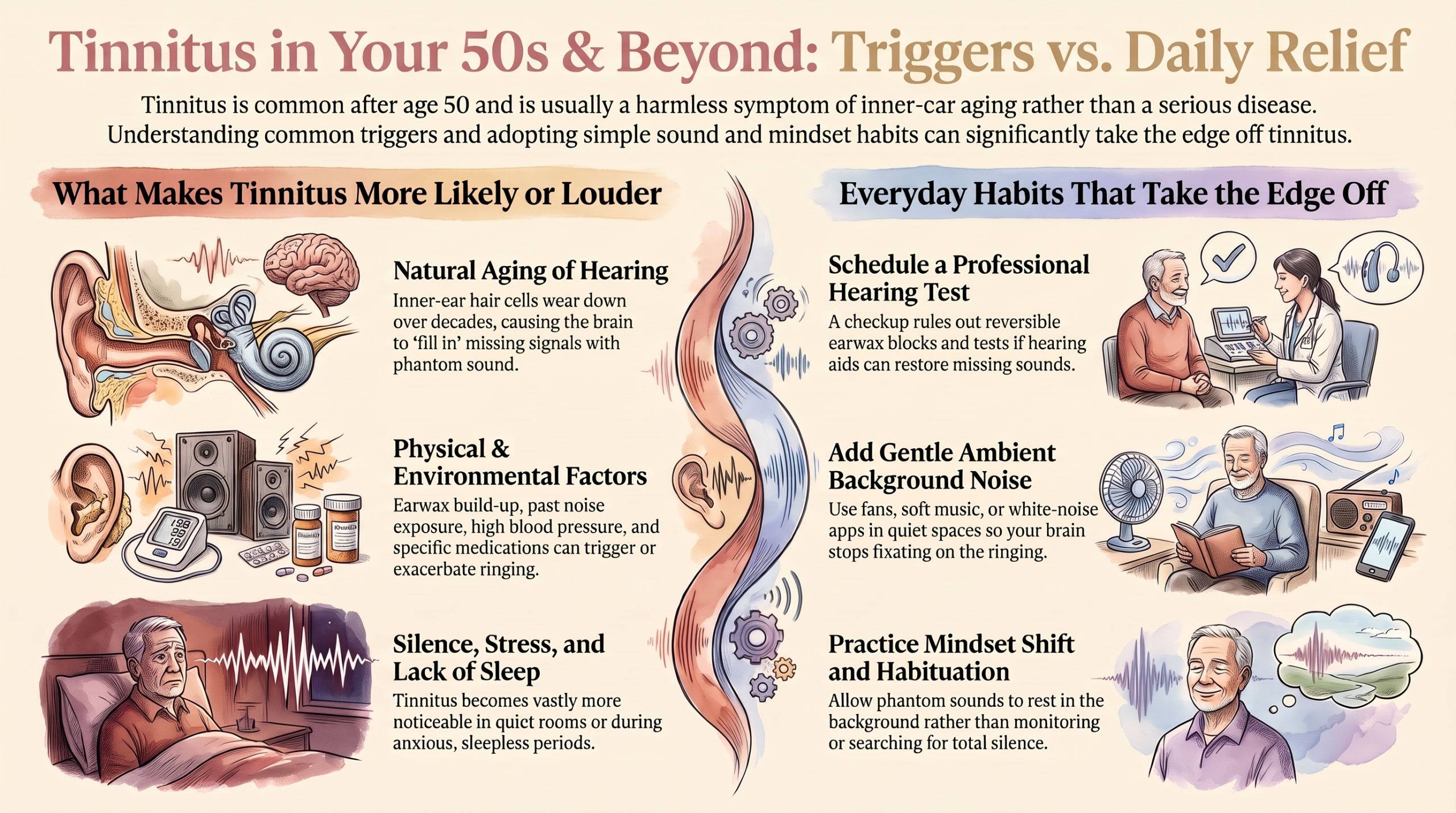
Tinnitus is the perception of sound — ringing, buzzing, hissing, clicking or even a soft roar — when there’s no external noise causing it. It isn’t a disease in itself; it’s a symptom, usually tied to changes in the hearing system as it ages. The inner ear’s tiny sound-sensing hair cells gradually wear down over decades of use, and when they do, the brain sometimes “fills in” the missing signal with phantom sound. That’s why tinnitus and age-related hearing loss so often travel together.
A few other everyday things make tinnitus more likely or more noticeable:
- A build-up of earwax. This is one of the few genuinely reversible causes — a blocked ear canal can trigger or worsen tinnitus, and clearing it (gently, or by a professional) sometimes resolves it completely.
- Noise exposure, past or present. Years of loud workplaces, concerts, power tools or even habitually loud headphones add up, even if the damage shows up decades later.
- Certain medications. High-dose aspirin, some antibiotics, and a few other drugs can cause or worsen tinnitus as a side effect — worth mentioning to your GP or pharmacist if a new tinnitus started around the time you began a new medication.
- Blood pressure and circulation. Tinnitus that pulses in time with your heartbeat (rather than a steady tone) is a different pattern and worth getting checked, since it’s sometimes linked to blood flow near the ear.
- Stress, poor sleep and silence itself. Tinnitus is often there all the time but only noticeable when everything else is quiet — which is why it can feel worse at night or during anxious periods, even though nothing has physically changed.
The good news: for the vast majority of people, tinnitus is annoying but not dangerous, and it very rarely gets progressively worse. Most people also find it bothers them less over time, as the brain gradually learns to tune it out — a process audiologists call habituation.

Mrs Cure Confidence Score
Evidence strength — Good
Practical value — High
Ease of following — Moderate
Cost — Mostly free
Suitability for over 50s — Strong
Mrs Cure’s Wise Take
I know how unsettling it is the first time you notice a sound that isn’t really there. But in nearly all cases, tinnitus is your ears telling you they’ve done a lot of listening over the years — not that something is badly wrong. The aim isn’t to make the sound disappear completely; it’s to stop it running the show. Most people get there.
What You Can Do Today
- Get your hearing checked. A hearing test can rule out earwax blockage and shows whether hearing aids might help — they often quiet tinnitus too, since they restore some of the sound the brain was “filling in” for.
- Add gentle background sound in quiet rooms. A fan, soft music, or a white-noise app at bedtime stops your brain fixating on the ringing in total silence.
- Review your medications with your pharmacist. Ask specifically whether anything you’re taking is known to affect tinnitus, and never stop a prescribed medication without talking to your GP first.
Effort vs Benefit
Very low effort for a meaningful payoff. A hearing check is a single appointment, background noise costs nothing, and most people notice their tinnitus becomes far less intrusive within weeks of simply not fighting it so hard. The one thing that takes real effort is the mindset shift — learning to let the sound sit in the background rather than straining to listen for it, which is exactly what audiologists and tinnitus retraining programmes are built around.
Things to Keep in Mind
See your GP if tinnitus appears suddenly in one ear only, comes with hearing loss or dizziness, pulses in time with your heartbeat, or is accompanied by pain or discharge — these patterns deserve a proper check, even though they’re still usually nothing serious. Cutting back on caffeine, alcohol and salt helps some people’s tinnitus and does nothing for others; it’s worth a personal experiment rather than a strict rule. And try not to go hunting for silence to “test” whether it’s still there — that habit alone can make tinnitus feel louder than it is.
Key Takeaway
Tinnitus is common after 50, usually harmless, and very rarely a sign of a serious underlying problem. A hearing check, a little background sound, and giving your brain permission to stop monitoring it are the three things that help almost everyone.
Mrs Cure Wisdom
Some sounds are worth straining to hear. This one isn’t — so give your ears, and your attention, a rest from it.
Enjoyed this? Get The Good Years, free.
Our free monthly magazine, packed with the best of our articles, guides and quizzes for life after 50. No spam, unsubscribe any time.
This content is educational and not a substitute for personalised medical advice, diagnosis or treatment.