That sudden spinning sensation when you turn over in bed isn’t something you have to just white-knuckle through.
Prefer to watch? Here’s the 82-second version.
Opening Summary
Dizziness and vertigo become noticeably more common after 50, and most of the time they trace back to specific, well-understood causes rather than anything mysterious: tiny crystals shifting inside the inner ear, blood pressure adjusting too slowly when you stand, or a medication quietly contributing to the feeling. The exact pattern of symptoms usually points toward a clear cause, and most causes respond well to a few straightforward steps.
The Story
“Dizzy” covers a lot of ground, and the words you use to describe it actually matter. True vertigo, the sensation that the room itself is spinning or tilting even though you’re standing still, is different from lightheadedness, a woozy, faint feeling that often comes with standing up quickly. Both become more common with age, but for different reasons, and telling them apart helps point toward the right fix.
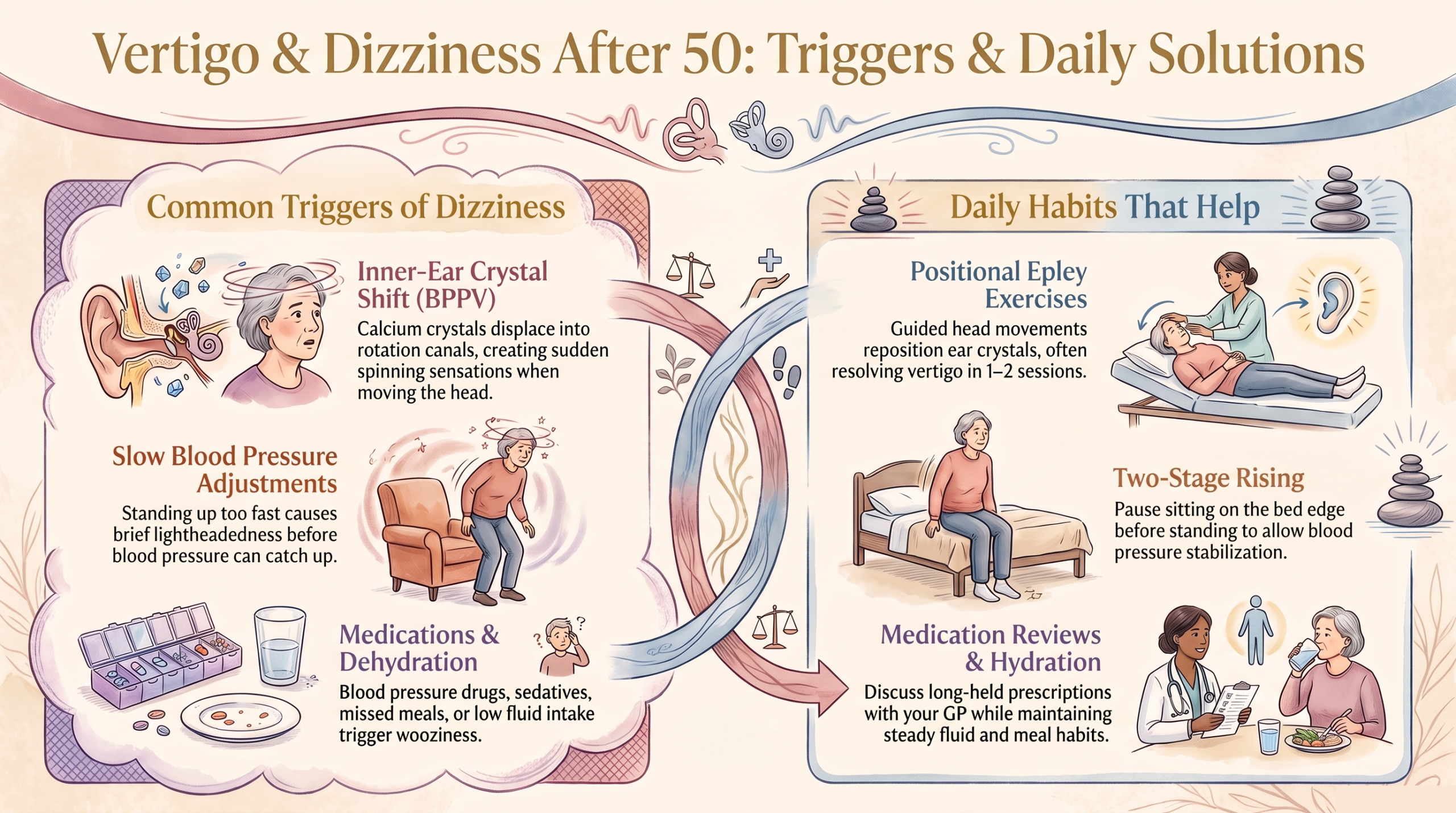
The single most common cause of true vertigo after 50 is benign paroxysmal positional vertigo, or BPPV, where tiny calcium crystals that normally sit in one part of the inner ear shift into a part of the ear that senses rotation. The result is a brief, intense spinning sensation triggered by specific head movements, rolling over in bed, looking up, bending down. It sounds alarming, but it’s mechanical, not dangerous, and often resolves quickly with the right treatment.
Get up from bed and chairs slowly, in stages. Sit at the edge of the bed for a few seconds before standing, giving your blood pressure time to catch up to the new position. This single habit prevents a large share of everyday lightheadedness.
Mention every medication to your GP, not just the new ones. Blood pressure tablets, sedatives, and even some long-term antidepressants are common, under-recognised contributors to dizziness, and the culprit is often a drug you’ve taken for years without issue.
Be precise about what “dizzy” means for you. Saying “the room was spinning” versus “I felt faint and woozy” points a doctor toward very different causes, so try to describe the actual sensation rather than reaching for the nearest general word.
A short course of positional exercises can resolve BPPV for good. A GP or physiotherapist can perform, or teach you, the Epley manoeuvre, a specific sequence of head movements that frequently clears the misplaced inner-ear crystals within one or two sessions.
Stay hydrated and don’t skip meals. Low blood sugar and mild dehydration both commonly tip people into feeling lightheaded, particularly later in the day or after a missed lunch.
Don’t just wait it out if it’s sudden, severe, or comes with other symptoms. Dizziness paired with slurred speech, facial drooping, sudden weakness down one side, or a severe headache needs emergency attention, as it can signal a stroke.

Mrs Cure Confidence Score
Evidence strength — Strong
Practical value — High
Ease of following — Moderate
Cost — Free
Suitability for over 50s — Strong
Mrs Cure’s Wise Take
A spinning room can feel frightening precisely because it feels unexplainable. Most of the time there’s a specific, findable, fixable cause behind it, so it’s worth seeking that answer rather than just getting used to the feeling.
What You Can Do Today
- Practise getting up from sitting and lying positions in two slow stages for the next few days.
- Write down exactly when dizziness happens: your position, the time of day, and what you’d just done.
- Book a GP appointment if episodes are new, frequent, or started after a medication change.
Effort vs Benefit
Low effort, high benefit: rising slowly from bed and chairs, keeping a simple symptom diary.
Moderate effort, high benefit: a medication review with your GP.
Requires real commitment: a course of vestibular physiotherapy for ongoing balance difficulties.
Things to Keep in Mind
Sudden, severe vertigo alongside slurred speech, facial drooping, limb weakness or a severe headache is a medical emergency, not something to wait out at home. This content is general guidance, not a diagnosis, speak to your GP about dizziness that’s new, frequent, or worsening. If unsteadiness on your feet is also a concern, our room-by-room fall-proofing checklist is worth a look too.
Key Takeaway
Dizziness and vertigo after 50 usually trace to specific, often very treatable causes, inner-ear crystals, blood pressure shifts, or medication effects, rather than being a vague, permanent feature of getting older.
Mrs Cure Wisdom
Your balance deserves an answer, not just an adjustment.
Enjoyed this? Get more like it.
Practical, no-nonsense health tips for adults 50+, dropped straight in your inbox. No spam, unsubscribe anytime.
This content is educational and not a substitute for personalised medical advice, diagnosis or treatment.