Prefer to watch? Here’s the 61-second version.
Opening Summary
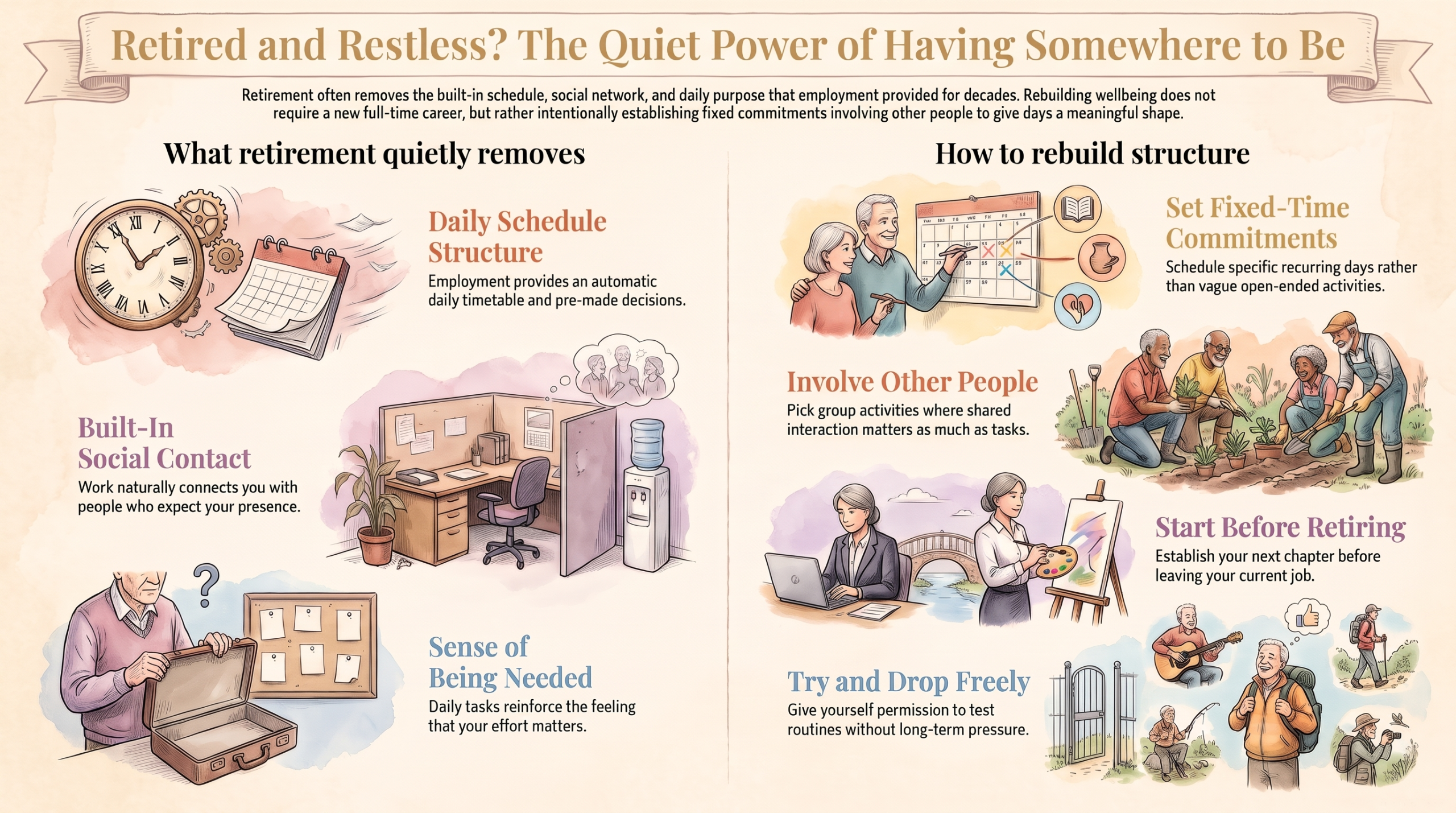
Plenty of people look forward to retirement for years and then find the reality quietly harder than expected, not because the rest isn’t welcome, but because the structure that used to organise a day is simply gone. Research on retirement and ageing keeps landing on the same finding: having a reason to get up, somewhere to be, or something that needs you, is linked with better mood, sharper thinking and even longer life. It isn’t about staying busy for its own sake. It’s about structure and purpose doing quiet, measurable work.
The Story
A job does more than pay the bills. It hands you a schedule, a set of people who expect you, small daily decisions already made, and a sense that your effort matters to someone. When that disappears all at once, as it often does on a specific retirement date, the loss can hit harder than most people expect, even when the work itself wasn’t missed. Studies following retirees over time consistently find a dip in wellbeing in the first year or two for people who retire without something else lined up to replace that structure, and a much smaller dip, or none, for those who do.
The encouraging part is that what fills the gap doesn’t have to be another job, or even especially ambitious. Volunteering, a regular class, caring for a grandchild on a set day, or a small business run at your own pace, all show up in the research as protective, largely because they restore the same three ingredients: a schedule, social contact, and a sense that you’re needed.
Pick something with a fixed time, not just a fixed activity. “Tuesday mornings” does more for your week than “whenever I feel like it”.
Choose something that involves other people, even loosely, since the social contact matters as much as the task itself.
Start before the gap opens up, if you can. People who line up a next chapter before their last working day report a noticeably smoother transition than those who wait to see how retirement feels first.
Give yourself permission to try something and drop it. The first thing you pick doesn’t have to be the right one forever.

Mrs Cure Confidence Score
Evidence strength — Good
Practical value — High
Ease of following — Moderate
Cost — Free
Suitability for over 50s — Strong
Mrs Cure’s Wise Take
I think we undersell how much of our sense of self is quietly held up by a schedule and a sense of being expected somewhere. Nobody warns you how much that matters until it’s gone, and the fix isn’t to fill every hour, it’s to put just enough structure back that your days have a shape again.
What You Can Do Today
Write down the three things your old routine gave you, structure, people, purpose, and think about where else each could come from.
Put one fixed commitment in next week’s diary, even something small, and treat it as non-negotiable.
Reach out to one organisation you’ve thought about, a charity, club or community group, just to ask what’s involved.
Ask a friend who’s retired well what actually filled their week, rather than guessing what should work.
Effort vs Benefit
Finding one regular, fixed commitment is a modest effort that research links to a meaningfully smoother retirement transition, better mood and in some studies better long-term cognitive health. It costs nothing but a conversation and a bit of trial and error, for a return that compounds over years rather than weeks.
Things to Keep in Mind
A flat, persistent low mood that doesn’t lift once some structure is back in place is worth raising with a doctor rather than assuming it’s just “retirement blues”; depression after 50 doesn’t always look like classic sadness, and retirement is a recognised trigger point for it. Give any new routine a genuine few months before judging whether it fits; the adjustment period is normal and doesn’t mean you’ve chosen badly.
Key Takeaway
Retirement removes a schedule, social contact and a sense of being needed all at once, and deliberately rebuilding even one of those three, ideally something with a fixed time and other people involved, does real, measurable good.
Mrs Cure Wisdom
You spent decades building a life around somewhere to be; it’s worth choosing your next somewhere on purpose, rather than waiting to see if one finds you.
Enjoyed this? Get The Good Years, free.
Our free monthly magazine, packed with the best of our articles, guides and quizzes for life after 50. No spam, unsubscribe any time.
This content is educational and not a substitute for personalised medical advice, diagnosis or treatment.