You don’t need to touch your toes or fold yourself in half to call it yoga — you just need to breathe, move a little, and pay attention.
Prefer to watch? Here’s the short video version.
Opening Summary
Gentle yoga is one of the few forms of movement that works on flexibility, balance and stress all at once, and it scales down easily for stiff joints, bad knees or a body that simply hasn’t stretched in years. This article looks at why a slower, chair-friendly style of yoga suits adults over 50 so well, what an actual beginner class looks like from start to finish, how it’s different from the fast-paced athletic yoga you might picture, and how to take your first session without feeling out of place.
The Story
Start with why it suits this decade so well. Joints get stiffer and balance gets less reliable with age, mostly because the small stabilising muscles around the ankles, hips and spine get less daily use than they used to. Gentle yoga asks those exact muscles to switch on, slowly and under control, which is a big part of why it shows up so often in fall-prevention and mobility research for older adults.
It meets your joints where they are, not where they used to be. A gentle class moves through a smaller range and holds each position for longer, which gives cartilage, tendons and ligaments time to warm up properly instead of being forced. If a full range of motion in the hip or shoulder isn’t there yet, a block, cushion or the seat of a chair simply closes the gap, so the pose still does its job without strain.
Balance training is quietly built in. Even a seated pose that shifts your weight from one hip to the other, or a standing pose done with a hand on a chair back, is training the same proprioception — your body’s sense of where it is in space — that keeps you steady on stairs or uneven pavement. You’re rarely told “now we’ll work on balance”; it’s woven into almost every pose.
The breathing does as much as the stretching. Slow nasal breathing paired with movement nudges the nervous system out of “on alert” mode and into rest-and-digest, which is where a lot of the calm people report actually comes from. It’s not mystical — it’s the same mechanism behind any deep-breathing relaxation technique, just paired with gentle movement instead of sitting still.
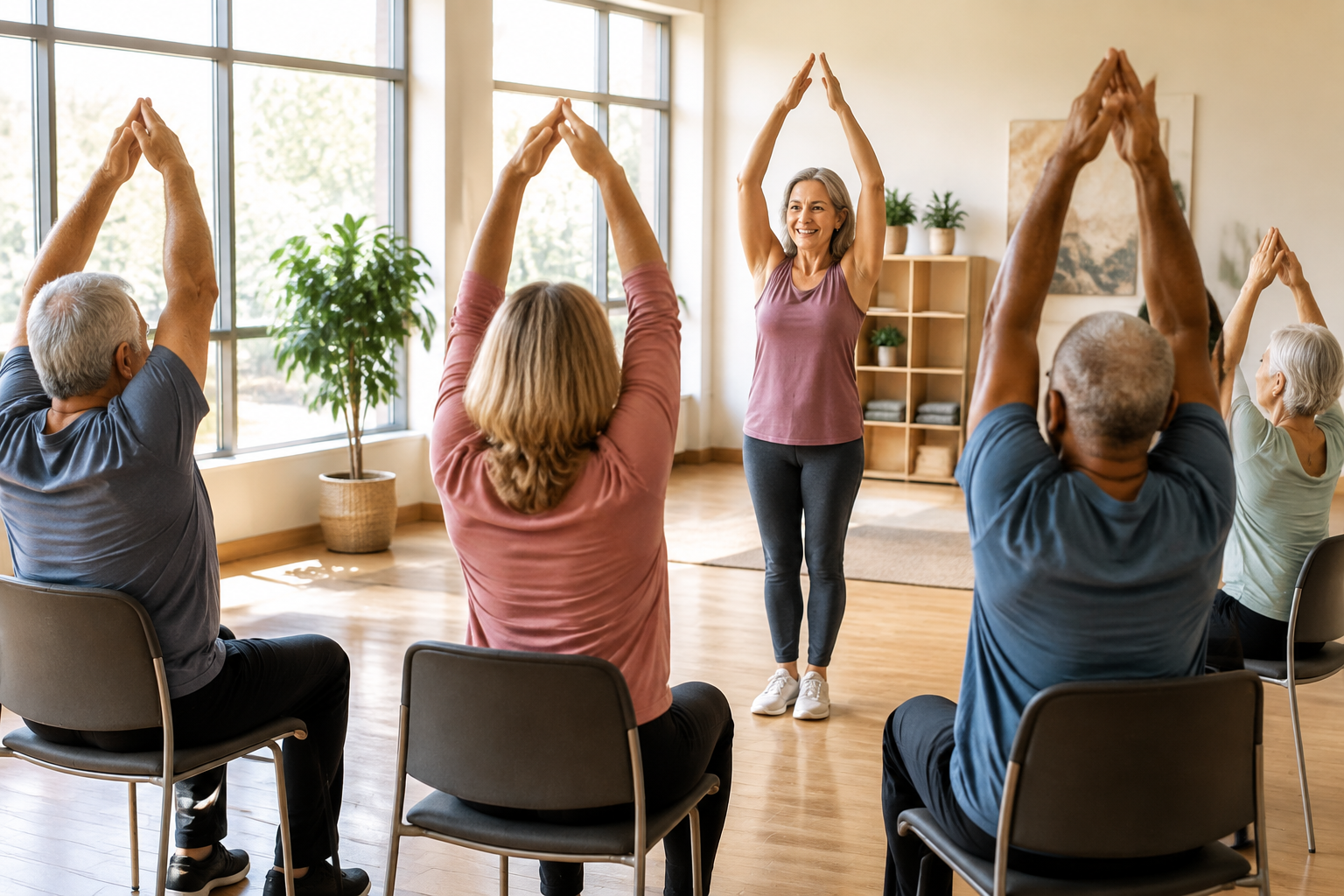
A beginner session is far less intimidating than it sounds. Expect a few minutes of settling in and breathing, a short warm-up for the neck, shoulders and spine, six to ten simple poses (many done seated or with a chair for support), and a few minutes lying or sitting quietly at the end. Nobody is chasing a “perfect” shape; the instructor is watching for tension, not judging your flexibility.
It’s a different animal from the athletic styles you might have in mind. Power yoga, vinyasa flow and hot yoga are built around speed, heat and strength endurance, with poses linked quickly one to the next. Gentle and chair yoga strip that pace away entirely: fewer poses, longer holds, more support, and no expectation of working up a sweat. Both are legitimately “yoga” — they’re just aimed at different goals.
Getting started is simpler than picking the “right” style. Look for a class explicitly labelled “gentle,” “chair” or “beginner” yoga, wear whatever you can move in comfortably, and bring a folded blanket or firm cushion if you don’t own a yoga block. Tell the instructor beforehand about any joint replacement, recent surgery or balance concern — a good one will quietly offer you an alternative for any pose that doesn’t suit.
Mrs Cure Confidence Score
Evidence strength — Good
Practical value — High
Ease of following — Easy
Cost — Low to Free
Suitability for over 50s — Strong
Mrs Cure’s Wise Take
The people who stick with gentle yoga aren’t usually the most flexible ones in the room — they’re the ones who stopped comparing themselves to anyone else in it, including who they used to be.
What You Can Do Today
- Search “gentle yoga” or “chair yoga” plus your town, or ask your local library, community centre or leisure centre if they run one — many do, often at low cost.
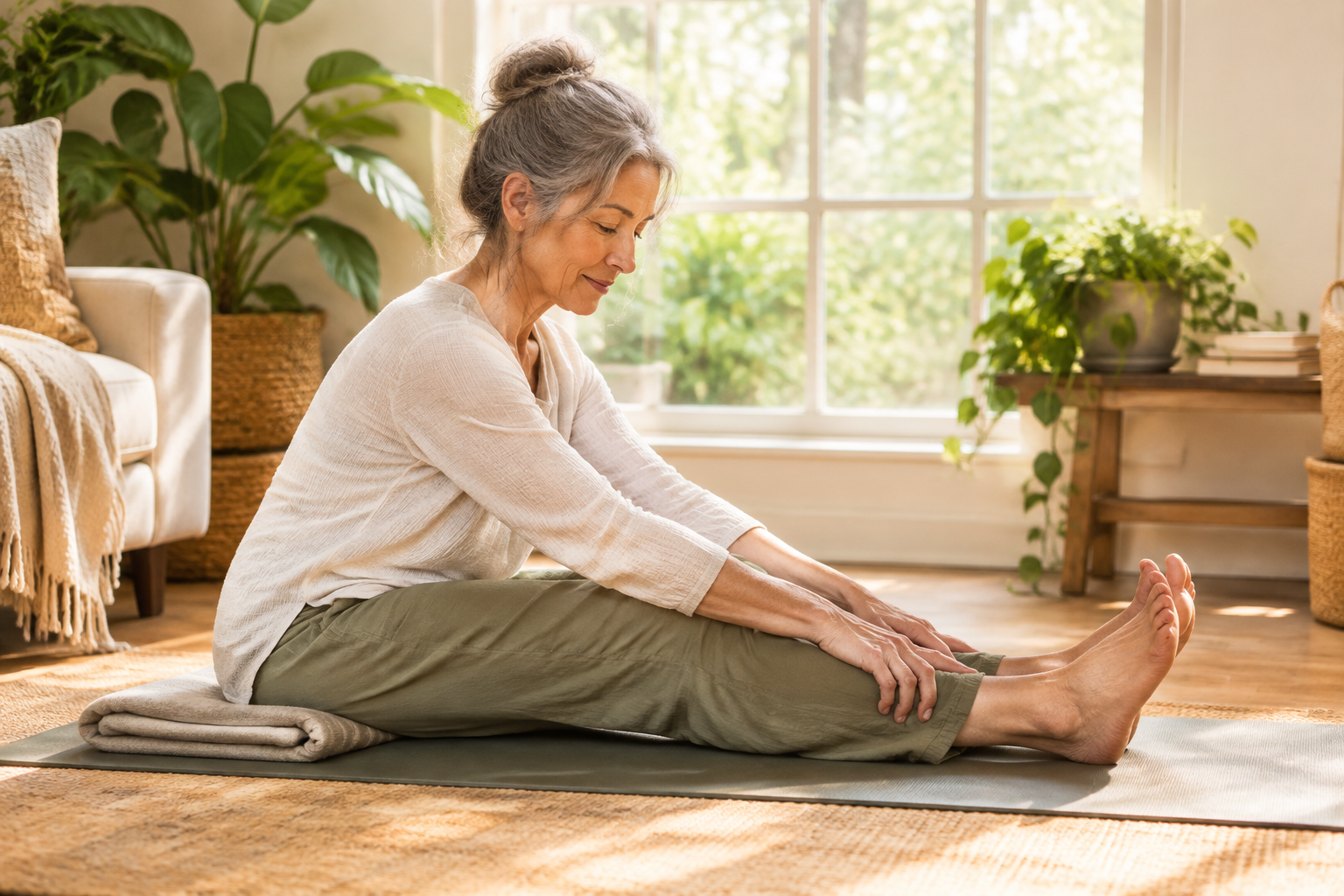
- Try one ten-minute seated stretch sequence at home this week: gentle neck rolls, shoulder circles, and a seated forward reach, done slowly with your breath.
- If you have any joint replacement, recent surgery, or a balance condition, jot down a one-line note to hand your instructor before your first class so they can adapt poses for you from the start.
Effort vs Benefit
A single gentle yoga session is genuinely low-effort: twenty to forty-five minutes, mostly seated or supported, at a pace your body sets. The benefit curve, though, is where it earns its place on this list — regular practice, even twice a week, tends to show up first as easier mornings and looser shoulders within a few weeks, with balance and flexibility gains building steadily after that. Where it shifts from moderate-effort to requires-commitment is consistency: like any gentle movement practice, the calm and mobility benefits fade if it’s done once and shelved, so the real return comes from treating it as a small, repeatable habit rather than a one-off try.
Things to Keep in Mind
Mild muscle tiredness or a gentle stretch sensation the day after a first class is normal and usually settles within a day or two. Sharp pain, dizziness, numbness or tingling during or after a pose is not something to push through — stop, rest, and mention it to your instructor or your GP before your next session. If you have a diagnosed condition affecting your joints, spine, blood pressure or inner ear balance, or you’re recovering from surgery, it’s worth a quick word with your doctor or a qualified instructor before starting, so any poses can be adapted rather than avoided altogether.
Key Takeaway
Gentle yoga isn’t a watered-down version of “real” yoga — it’s yoga built specifically for the body you have today, and it delivers real, evidence-backed gains in flexibility, balance and stress reduction without asking you to sweat, twist or strain to get them. Whether you start with a class, a chair, or ten quiet minutes at home, the version that fits your body is the one worth doing.
Mrs Cure Wisdom
You don’t earn calm by working harder for it — sometimes you just have to sit down, breathe, and let your body catch up.
Enjoyed this? Get more like it.
Practical, no-nonsense health tips for adults 50+, dropped straight in your inbox. No spam, unsubscribe anytime.
This content is educational and not a substitute for personalised medical advice, diagnosis or treatment.