The most effective exercise after 50 probably isn’t the one that costs the most or looks the most impressive — it might just be the one you can start doing from your own front door.
Prefer to watch? Here’s the 78-second version.
Opening Summary
Walking is one of the most consistently evidence-backed forms of exercise for adults over 50, linked in large studies to lower rates of heart disease, stronger bones, better balance, and improved mood. It’s also one of the most accessible: no equipment, no membership, and almost no barrier to simply starting today. The benefits scale with consistency far more than with speed or distance, which makes walking an unusually forgiving habit to build.
The Story
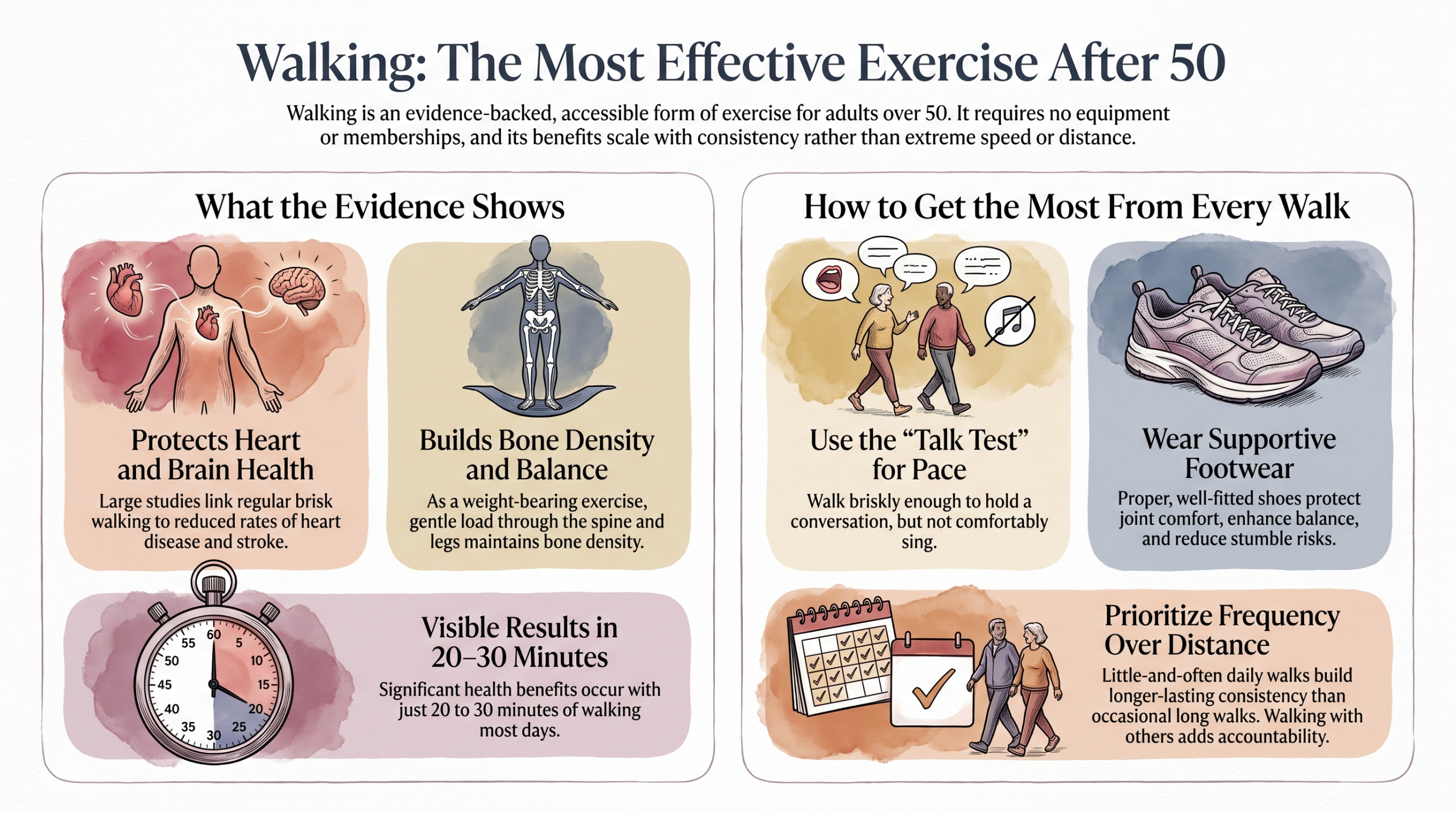
Walking counts as real exercise — the evidence here is substantial, not just folk wisdom. Large population studies consistently link regular brisk walking with lower rates of heart disease, stroke, and early death, with benefits visible even at modest amounts like 20–30 minutes most days. This isn’t a lesser substitute for ‘real’ exercise; for most adults over 50, it’s a genuinely effective one on its own.
Pace matters almost as much as distance. A useful rule of thumb is the ‘talk test’: walking briskly enough that you could hold a conversation but couldn’t comfortably sing tends to sit in the ideal zone for cardiovascular benefit. A slow stroll still has value, but picking up the pace where you comfortably can adds meaningfully more.
It’s weight-bearing, which means it works on your bones, not just your heart. Unlike swimming or cycling, walking puts repeated, gentle load through the legs and spine, which is exactly the kind of stress bones need to maintain density. This makes it a particularly good complement to other low-impact exercise, rather than a replacement for all of it.
Walking with others adds a layer of benefit most people don’t expect. Regular walking groups or walking with a friend combine the physical benefits with genuine social connection, and the accountability of a standing arrangement tends to make the habit stick considerably better than going it alone. It’s one of the easiest ways to tackle two things at once.
Supportive footwear matters more after 50 than most people realise. Worn-out or unsupportive shoes can quietly affect balance, joint comfort, and the likelihood of a stumble, all of which matter more as the years add up. A proper, well-fitted walking shoe is a small cost against a real reduction in discomfort and fall risk.
Little and often beats occasional long walks for actually building the habit. A short walk most days tends to produce better long-term consistency, and comparable health benefit, than an ambitious long walk once a week that’s easy to skip when life gets busy. Starting smaller than feels impressive is usually the better strategy.
Mrs Cure Confidence Score
Evidence strength — Strong
Practical value — Very High
Ease of following — Easy
Cost — Free
Suitability for over 50s — Very Strong
Mrs Cure’s Wise Take
It’s tempting to assume the exercise that counts is the one that leaves you sore the next day — but for most people over 50, the exercise that counts most is simply the one that actually happens, again and again.
What You Can Do Today
- Plan one specific time today for a walk, even 15 minutes, rather than leaving it to ‘if there’s time.’
- Try the talk test on your next walk — pick up the pace until conversation feels slightly effortful, and notice the difference.
- Check your current walking shoes for wear, and consider whether they’re still giving you real support.
- Ready to build it into a habit? Follow our free 12-week walking plan for over-50s, with a printable plan and log.
Effort vs Benefit
Fitting in a short daily walk is about as low-effort as exercise gets, for a return that genuinely rivals far more demanding routines. Picking up the pace to hit a brisk, talk-test level takes a little more intention but meaningfully increases the cardiovascular benefit. Building a standing walking arrangement with a friend or group takes the most coordination to set up, but tends to produce the most lasting habit of the three.
Things to Keep in Mind
If walking brings on chest pain, breathlessness well beyond what feels normal for the effort, or new joint pain, that’s worth checking with a GP rather than pushing through it. Anyone starting from a very sedentary place, recovering from illness, or managing balance concerns should build up gradually and choose stable, well-lit surfaces, taking extra care with footwear.
Key Takeaway
Walking is one of the few exercises with evidence this strong behind it, this little barrier to starting, and this much flexibility to fit around real life — which makes consistency, not intensity, the thing most worth focusing on.
Mrs Cure Wisdom
You don’t need the perfect walk — you just need today’s walk, and then tomorrow’s.
Enjoyed this? Get more like it.
Practical, no-nonsense health tips for adults 50+, dropped straight in your inbox. No spam, unsubscribe anytime.
This content is educational and not a substitute for personalised medical advice, diagnosis or treatment.